






Cat Whiskers: Everything You Need to Know
Those long whiskers around your cat’s face may look like ordinary hairs, but they are much more important than they appear.
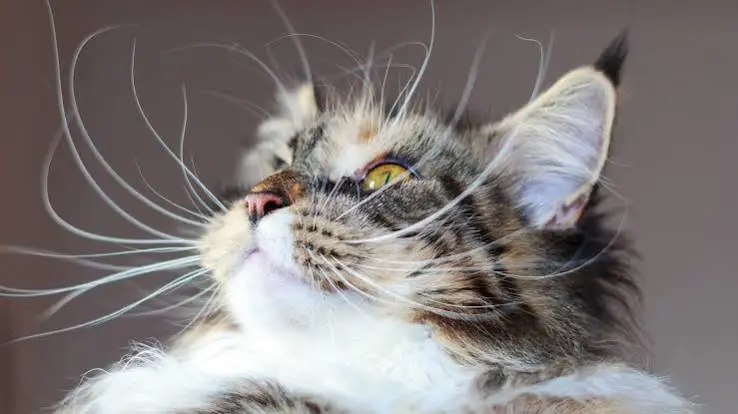
Cat whiskers are specialized sensory structures that help cats understand their surroundings. They can detect touch, movement, and subtle changes in air currents, giving cats useful information when they explore, hunt, jump, and move through unfamiliar spaces.
Whiskers also play a role in communication.
You may notice your cat pushing its whiskers forward when it is interested in something or pulling them closer to the face when it appears nervous or uncomfortable. Watching whisker position alongside the rest of your cat’s body language can provide useful clues about how your cat is feeling.
These specialized hairs are called vibrissae.
They are deeply rooted in the skin and connected to sensory nerves, making them extremely sensitive to environmental information.
So why do cats have whiskers, and why are they so important?
Let’s look at how these remarkable sensory tools work.
What Are Cat Whiskers?
Cat whiskers are thick, specialized hairs that function as highly sensitive sensory structures.
The most noticeable ones grow from the sides of your cat’s muzzle, but whiskers are not limited to the area around the nose.
Cats can also have whiskers:
- Above the eyes
- Around the cheeks
- Near the chin
- Along the jaw
- On the front legs
The whiskers on the front legs are called carpal vibrissae. They can provide additional sensory information, particularly during activities such as hunting and exploring.
Unlike ordinary fur, whiskers are deeply embedded in specialized follicles that contain many sensory nerve connections.
When a whisker moves or comes into contact with something, information can travel through those sensory connections to the cat’s brain.
This gives your cat another way to gather information about the world.
What Is the Function of Cat Whiskers?
The main cat whiskers function is sensory.
Whiskers help cats detect information about nearby objects and changes in their environment.
They can help a cat:
- Detect objects close to its face
- Sense air movement
- Judge nearby spaces
- Navigate in low light
- Detect potential obstacles
- Support hunting behavior
- Communicate emotional states
Think of whiskers as part of your cat’s built-in environmental detection system.
Your cat does not rely only on its eyes.
It also receives information through its whiskers.
For example, if your cat walks toward an object in a dark room, the whiskers may detect changes in the surrounding air or make contact with the object before the cat fully sees it.
That extra information can help the cat move more confidently through its environment.
Why Do Cats Have Whiskers?
Cats have whiskers because they provide important sensory information.
A cat’s eyes are excellent for detecting movement and seeing in low light, but whiskers provide additional information about objects that are very close.
This is especially useful when a cat is exploring a narrow or unfamiliar space.
Whiskers can detect small movements and vibrations around the cat.
Their follicles are surrounded by sensory cells that send information to the nervous system.
This makes whiskers an important part of how cats interact with their surroundings.
For a hunting cat, this ability can be particularly useful.
When prey is extremely close, the cat’s whiskers can help provide information about its position and movement.
Even an indoor cat uses these sensory abilities every day while playing, exploring, climbing, and moving around the home.
How Do Cat Whiskers Work?
The secret behind whiskers is not simply the hair itself.
The important sensory structures are located around the follicle where each whisker grows.
These follicles contain many nerves and sensory cells.
When a whisker bends because it touches an object or responds to movement in the air, the surrounding sensory system detects that change.
The information is then transmitted to the cat’s brain.
This allows your cat to gather information about its surroundings without necessarily seeing or directly touching an object with its body.
PetMD notes that whisker follicles can contain very large numbers of neurons, which helps explain why these structures are so sensitive.
So although the visible whisker looks like a long strand of hair, the system underneath it is much more complex.
Are Cat Whiskers Just Hairs?
Not exactly.
Whiskers are made of keratin, like ordinary hair, but their sensory role makes them very different from normal fur.
The visible hair itself does not contain nerves and therefore cutting the hair is not painful in the same way as cutting living tissue.
However, the follicle where the whisker grows is highly sensitive.
This is why whiskers should not be casually trimmed.
Your cat relies on the sensory information they provide, and removing them can interfere with how the cat interprets its surroundings.
It is helpful to think of the visible whisker as the part that moves, while the sensitive follicle underneath acts as the information-gathering system.
A cat’s teeth are important for eating and overall health, so check out our Cat Teeth guide to learn about their structure, development, and common dental problems.
Where Are Cat Whiskers Located?
Most people notice the long whiskers on the sides of a cat’s nose first.
However, cats have several groups of whiskers around their bodies.
You may find them:
Around the Muzzle
These are the most obvious whiskers.
They extend outward from both sides of the face and provide important sensory information about nearby objects.
Above the Eyes
Whiskers above the eyes can help protect the sensitive eye area.
If something touches these whiskers, the sensory response can help trigger protective reactions such as blinking.
Around the Chin and Jaw
Smaller whiskers can also be found around other parts of the face.
They contribute to the cat’s overall sensory system.
On the Front Legs
Cats also have carpal whiskers on the back of their front legs.
These are less obvious than facial whiskers but can provide useful information during hunting and interaction with objects.
So the next time you see a whisker on your cat’s face or front leg, remember that it is not simply an unusual piece of fur.
It is part of a much larger sensory system.
How Many Whiskers Does a Cat Have?
The number can vary between individual cats, but cats commonly have around 24 prominent whiskers around the muzzle, with approximately 12 on each side.
These whiskers are arranged in an organized, roughly symmetrical pattern.
You may notice several rows extending from each side of the muzzle.
The exact number and arrangement can vary, so you should not worry if you cannot count exactly 24 on your cat.
Cats also have additional whiskers in other areas, including above the eyes, around the chin, and on the front legs.
Together, these different whisker groups provide sensory information from multiple areas of the body.
Why Are Cat Whiskers So Sensitive?
Cat whiskers are highly sensitive because their follicles are connected to a dense network of sensory structures.
This allows cats to detect very small movements of the whiskers.
They can respond to:
- Light contact
- Vibrations
- Air currents
- Nearby objects
- Changes in their surroundings
This sensitivity is extremely useful for an animal that moves through narrow spaces and hunts at close range.
Imagine walking through a dark room with your hands stretched slightly in front of you.
Your hands could tell you when you were getting close to something.
Your cat’s whiskers provide a somewhat similar source of environmental information, although they work through a specialized sensory system.
This is one reason why whiskers matter so much to cats.
Do Cat Whiskers Help With Balance?
Whiskers can contribute to a cat’s awareness of its orientation and surroundings.
Sensory structures associated with whisker follicles can provide information about the position and movement of the whiskers.
This information is processed by the nervous system along with other sensory input.
Whiskers are therefore one part of the larger system cats use to coordinate movement and understand where their bodies are in relation to their surroundings.
However, it would be inaccurate to say that whiskers are the only thing responsible for a cat’s balance.
Balance depends on several sensory systems working together.
Whiskers simply provide another useful source of information.
How Do Whiskers Help Cats Judge Tight Spaces?
One of the most interesting functions of cat whiskers is helping cats gather information about narrow spaces.
A cat may put its head into an opening before moving its entire body through it.
The position and movement of the whiskers provide additional information about the surrounding space.
Because the facial whiskers extend outward from the face, they can help the cat assess whether an opening appears large enough to move through.
This can be especially useful when a cat is exploring:
- Boxes
- Small gaps
- Under furniture
- Bushes
- Narrow hiding places
Of course, whiskers are not a perfect measuring tape.
A cat’s body size can change over time, while whisker length does not necessarily change proportionally.
So whiskers should be considered one source of information rather than a precise measurement tool.
Do Whiskers Help Cats See in the Dark?
Whiskers do not give cats actual night vision.
Cats already have highly adapted eyes that allow them to see well in low-light conditions.
However, whiskers provide additional information that can help cats navigate when visibility is limited.
They can detect changes in air currents and respond to objects close to the face.
This can help a cat avoid obstacles and understand its surroundings even when lighting is poor.
For example, imagine your cat walking through a dark hallway at night.
Its eyes provide visual information, while its whiskers can provide additional sensory information about objects nearby.
This combination helps explain why cats can move through their environment so confidently in dim light.
How Do Whiskers Help Cats Hunt?
Whiskers are particularly useful during close-range hunting.
A cat may use its eyes to track prey, while its whiskers provide additional information about nearby movement and air currents.
When the prey gets very close, the cat needs more than just distant visual information.
The whiskers around the muzzle and the carpal whiskers on the front legs can provide additional sensory clues during the final stages of interaction with prey.
Your indoor cat may demonstrate the same natural behavior with a toy.
When your cat grabs a toy mouse, watch how its whiskers may shift forward while it concentrates.
The toy may not be real prey, but many of the same natural behaviors can still appear during play.
Cat Whisker Positions, Communication, Whisker Fatigue and Care
What Do Different Cat Whisker Positions Mean?
Cat whiskers do more than help with sensing the environment. Their position can also provide clues about your cat’s emotional state.
You should not interpret whisker position by itself. Instead, look at the ears, eyes, tail, body posture, and overall behavior at the same time.
Still, whiskers can be a useful part of understanding cat body language.
A relaxed cat may hold its whiskers in a natural position beside the face.
When a cat becomes interested in something, its whiskers may move forward.
When a cat feels frightened or threatened, the whiskers may be pulled back closer to the cheeks.
What Do Forward-Facing Cat Whiskers Mean?
When your cat’s whiskers are pushed forward, it may be showing interest or increased attention.
This can happen when your cat is:
- Watching a bird
- Playing with a toy
- Investigating a new object
- Hunting
- Exploring something interesting
For example, imagine your cat sitting near a window watching a bird outside.
Its eyes may become focused, its body may become still, and its whiskers may move forward.
The whiskers are part of the cat’s overall sensory and behavioral response to something interesting.
Forward whiskers can therefore be a useful clue that your cat is engaged with its surroundings.
What Do Pulled-Back Whiskers Mean?
Whiskers pulled tightly toward the face can occur when a cat feels frightened, threatened, or uncomfortable.
You may notice this position alongside:
- Flattened ears
- A tense body
- Dilated pupils
- Hiding
- Hissing
- A tucked or lowered body
For example, if a stranger enters the room and your cat immediately hides while pulling its whiskers back, the overall body language suggests that the cat feels uncomfortable.
Whiskers alone cannot tell you exactly what your cat is feeling.
But when combined with the rest of the body’s signals, they can provide useful information.
What Do Relaxed Cat Whiskers Look Like?
A relaxed cat usually has whiskers that are neither strongly pushed forward nor tightly pulled backward.
They may extend naturally from the sides of the face.
You might see this when your cat is:
- Resting
- Sleeping lightly
- Sitting comfortably
- Grooming
- Relaxing beside you
If your cat is lying on the sofa with relaxed muscles, soft eyes, normal ears, and naturally positioned whiskers, there is usually no reason to worry about the whiskers themselves.
Remember that every cat has its own normal facial appearance.
Learning what your cat normally looks like is more useful than trying to compare it with another cat.
Can Cat Whiskers Show Pain or Stress?
Changes in whisker position can sometimes accompany stress or discomfort.
A cat that feels unwell may pull its whiskers backward or hold its face in an unusual expression.
However, whiskers should never be used as a stand-alone method for diagnosing pain.
Cats can hide illness surprisingly well.
If your cat’s whiskers suddenly look different and you notice changes such as hiding, reduced appetite, unusual aggression, lethargy, or changes in movement, pay attention to the complete picture and contact your veterinarian when appropriate.
Do Cat Whiskers Fall Out?
Yes.
It is normal for cats to occasionally lose individual whiskers.
Just like ordinary hair, whiskers go through a natural growth and shedding cycle.
You may discover a whisker on:
- Your sofa
- Your bed
- A blanket
- The floor
- Your cat’s favorite sleeping spot
Finding one or two loose whiskers is generally not a reason to panic.
A new whisker can grow from the same follicle after the old one is shed, provided the follicle itself remains healthy.
Do Cat Whiskers Grow Back?
Yes, cat whiskers generally grow back if the follicle has not been damaged.
The process is not necessarily quick.
A facial whisker can take several weeks to months to return to its functional length.
PetMD notes that regrowth can take roughly 6 weeks to 3 months, depending on the individual cat and circumstances.
So if you find a single whisker on the floor, there is usually no need to worry.
Your cat may simply be replacing an old one.
Sometimes a new whisker may even grow back a different color.
That does not necessarily mean there is a health problem.
Should You Cut Cat Whiskers?
No. You should not intentionally trim your cat’s whiskers.
Although the visible whisker itself is made from keratin like ordinary hair and does not contain pain-sensing nerves, the follicle where it grows is highly sensitive and connected to sensory nerves.
Whiskers provide important information about the environment.
Removing or shortening them can interfere with that sensory input and may leave a cat confused or stressed.
Imagine suddenly losing one of the ways you normally understand where objects are around you.
Your cat may experience a similar disruption when its whiskers are unnecessarily removed.
For this reason, there is no reason to trim a healthy cat’s whiskers for grooming or appearance.
Does Cutting a Cat’s Whiskers Hurt?
Cutting the visible hair itself is not the same as cutting living tissue, so trimming the hair is not usually painful in the way cutting skin would be.
The bigger concern is the loss of sensory information.
Because whiskers are important sensory structures, trimming them can interfere with how your cat gathers information about nearby objects and its environment.
Pulling out a whisker is completely different and should never be done.
The follicle is highly sensitive, and deliberately removing whiskers can cause pain and unnecessary distress.
Can a Cat Lose Whiskers Naturally?
Yes.
Cats naturally shed individual whiskers.
You might find one on the floor without ever noticing your cat lose it.
This is different from a cat suddenly losing many whiskers.
If you notice widespread whisker loss, broken whiskers, irritated skin, or changes around the follicles, speak with a veterinarian.
Certain skin problems and some medical treatments can affect whisker growth or cause whiskers to fall out.
What Is Whisker Fatigue in Cats?
Whisker fatigue is a term used to describe possible stress or discomfort caused by repeated stimulation of a cat’s sensitive whiskers.
The idea is that when whiskers repeatedly press against the sides of a food or water bowl, the sensory system may become overstimulated.
Some cats may appear uncomfortable around their bowls as a result.
However, this topic needs an important clarification.
Whisker fatigue is not considered a clearly established disease, and the veterinary community does not universally agree that it is a distinct medical condition. There is limited research on the subject, and one study found no significant difference in eating behavior between cats using whisker-friendly and regular bowls, although some cats did show individual preferences.
So it is better to think of whisker fatigue as a possible explanation for certain feeding behaviors rather than a confirmed diagnosis.
What Are the Signs of Possible Whisker Stress?
A cat experiencing possible whisker-related discomfort around a food bowl may:
- Paw food out of the bowl
- Eat food from the floor instead
- Pace around the bowl
- Act hungry but hesitate to eat
- Become unusually irritated around feeding time
However, these behaviors can have many other causes.
Dental disease, gastrointestinal problems, kidney disease, stress, nausea, and other health conditions can also affect eating behavior.
This is why you should not automatically assume that a cat refusing food from a bowl has whisker fatigue.
If your cat’s appetite changes significantly, veterinary evaluation is important.
What Kind of Food Bowl Is Better for a Cat’s Whiskers?
If you suspect that your cat dislikes having its whiskers repeatedly touch the sides of a bowl, you can try a wide, shallow dish.
The idea is simple.
A wider dish allows the cat to access its food without pressing the sides of its face and whiskers against the container as much.
Some cats may prefer this setup even though research has not established whisker fatigue as a definite medical condition.
You can observe your cat’s preference.
If your cat happily eats from a shallow dish but repeatedly removes food from a deep bowl, the shallower option may simply be more comfortable for that individual cat.
Should You Trim Whiskers Because of Whisker Fatigue?
No.
Trimming whiskers is not the recommended solution.
If your cat appears uncomfortable while eating, changing the bowl to a wider, shallower option may be reasonable to try.
But if the eating problem continues, do not assume it is whisker fatigue.
Your cat could have an entirely different problem, including dental pain or another illness.
A sudden change in eating behavior deserves attention.
Do Cat Whiskers Help Protect Their Eyes?
Yes.
Whiskers around the eyes can act as sensitive warning structures.
If something touches them, the cat may respond by blinking, moving its head, or otherwise reacting to the potential threat.
This can help protect sensitive areas of the face.
For example, if a small object or plant brushes against the whiskers above your cat’s eyes, the sensory response can alert the cat before the object directly contacts the eye.
This is another reason whiskers are more than decorative facial hairs.
Are Whiskers Important for Cat Communication?
Whisker position can be part of feline communication.
Cats use many body signals at the same time, including:
- Ear position
- Eye shape
- Tail movement
- Body posture
- Facial expression
- Whisker position
A relaxed cat may have naturally positioned whiskers.
An interested cat may push them forward.
A frightened or threatened cat may pull them backward toward its cheeks.
This makes whiskers useful when reading cat body language.
However, never interpret one whisker position in isolation.
For example, forward whiskers during play can mean interest and excitement, while other body signals may tell you whether the cat is becoming overstimulated.
Do All Cats Have the Same Whiskers?
No.
Cats have individual differences in whisker length, thickness, shape, and arrangement.
Some cats have very long whiskers.
Others have shorter or more curved whiskers.
Certain breeds can have distinctive whisker characteristics.
For example, the Cat Fanciers’ Association notes that some Rex breeds can have wavy or curly whiskers, while larger cats may have correspondingly impressive whiskers.
So your cat’s whiskers do not need to look exactly like another cat’s whiskers to be normal.
Can Whiskers Break?
Yes.
A whisker can occasionally break because of normal activity, rough play, or other physical contact.
A single broken whisker is usually not an emergency.
However, repeated breakage or widespread changes may deserve attention.
Avoid pulling on broken whiskers or attempting to remove them yourself.
If the skin around the whisker follicles looks irritated or your cat develops other unusual symptoms, ask your veterinarian for advice.
Can Whiskers Change Color?
Yes.
Whiskers can sometimes change color as a cat ages.
For example, a whisker that was previously white may become darker or grayish.
Changes in whisker color do not automatically mean that something is wrong.
Just like fur can change with age, whiskers can also show natural pigmentation changes.
What Should You Do If Your Cat Loses a Whisker?
Usually, nothing special is required if your cat loses an occasional whisker.
Simply leave the area alone and allow the whisker to naturally grow back.
Do not try to pull out other whiskers to “even them out.”
You also do not need to keep replacing a whisker that has fallen out.
Your cat’s body naturally manages the growth cycle.
If you notice many whiskers disappearing at once, broken whiskers combined with skin changes, or other signs of illness, contact your veterinarian.
Why Should You Never Pull Out Cat Whiskers?
Whisker follicles contain a dense network of sensory nerves.
Pulling out a whisker can therefore cause pain and unnecessary stress.
It also removes an important sensory structure before it has naturally completed its growth cycle.
There is no benefit to pulling out healthy whiskers.
If one falls out naturally, allow the new one to grow normally.
Your cat’s whiskers have an important job, so they are best left alone.
What Happens If a Cat’s Whiskers Are Damaged?
Damage to whiskers can temporarily reduce the sensory information available to a cat.
A cat with missing or shortened whiskers may become more hesitant when moving around, particularly in unfamiliar surroundings.
PetMD notes that damage to whiskers can affect a cat’s spatial awareness, coordination, and confidence.
Fortunately, whiskers generally regrow when their follicles remain healthy.
During the regrowth period, simply provide your cat with a calm and familiar environment.
There is usually no need to do anything directly to the whiskers themselves.
Cat Whisker Care, Common Problems, FAQs and What Owners Should Know
How Should You Care for Your Cat’s Whiskers?
The good news is that cat whiskers usually do not require special grooming.
Unlike fur, whiskers should not be brushed, trimmed, curled, or styled.
The best way to care for them is simply to leave them alone.
You can help protect your cat’s whiskers by:
- Avoiding unnecessary trimming
- Never pulling out whiskers
- Providing a comfortable feeding setup
- Keeping the cat’s environment safe
- Watching for sudden changes
- Avoiding rough handling around the face
Your cat’s whiskers are naturally designed to maintain themselves.
You do not need to make them look perfectly straight or symmetrical.
Should You Clean Cat Whiskers?
Normally, cats clean themselves, including the area around their face.
You generally do not need to clean healthy whiskers separately.
If food or dirt gets stuck around the face, you can gently wipe the surrounding fur with a clean, damp cloth if your cat tolerates it.
Do not aggressively rub the whiskers.
You should also avoid applying human skincare products, perfumes, oils, or other substances around the whisker follicles.
If the area around the whiskers becomes persistently dirty, crusty, swollen, or irritated, the cause should be investigated rather than simply cleaned repeatedly.
Why Does My Cat’s Whisker Area Look Dirty?
Occasionally, food or water can become trapped around the mouth and whiskers.
This is especially noticeable in cats with long facial fur.
However, persistent crusting or dirt-like material around the whisker follicles can sometimes indicate a skin problem.
Watch for:
- Redness
- Swelling
- Crusts
- Hair loss
- Excessive scratching
- Repeated face rubbing
If these signs continue, speak with a veterinarian.
A healthy whisker area should not continually appear inflamed or irritated.
Why Does My Cat Rub Its Face on Things?
Cats often rub their faces against furniture, walls, people, and other objects.
This behavior is sometimes called bunting when a cat presses or rubs its head against you.
The face contains scent glands, so rubbing can help cats leave their scent on objects and familiar people.
It can also be part of social interaction.
For example, your cat may walk over, gently bump its head against your hand, and then rub its cheek against your arm.
That can be a friendly interaction.
The whiskers themselves are not necessarily the reason for the behavior, but they are part of the sensitive facial area involved in how cats experience their surroundings.
Why Does My Cat Move Its Whiskers When Playing?
A cat’s whiskers may move noticeably during play.
When your cat becomes focused on a toy, its whiskers may move forward.
This can happen because the cat is concentrating on something nearby.
You may notice this especially when your cat is:
- Stalking a toy
- Preparing to pounce
- Watching moving objects
- Catching a toy
- Investigating something unfamiliar
The movement is part of the cat’s overall sensory and behavioral response.
Look at the rest of the body language too.
A playful cat may have an alert body, focused eyes, and active movements, while a frightened cat may show tension, flattened ears, and pulled-back whiskers.
Why Does My Cat’s Whiskers Point Forward When Hunting?
Forward-facing whiskers can occur when a cat is highly interested in something nearby.
During hunting or play, your cat needs information about objects and movement close to its face.
Moving the whiskers forward may help position these sensitive structures toward the area of interest.
You might see this when your cat watches:
- A toy mouse
- A bird through a window
- An insect
- Another animal
- A moving object
Even indoor cats retain these natural hunting behaviors.
Your cat may never need to hunt for dinner, but its whiskers still participate in the sensory system that evolved for hunting and exploration.
Why Does My Cat Pull Its Whiskers Back When Scared?
When a cat feels frightened or threatened, it may pull its whiskers closer to the face.
This can make the whiskers appear less spread out.
At the same time, you may see:
- Ears flattened backward
- Wide eyes
- A tense body
- Tail movement
- Hiding
- Hissing or growling
This combination is more meaningful than whisker position alone.
If your cat suddenly encounters a loud noise, for example, it may pull its whiskers back while trying to decide whether to hide or escape.
Giving the cat space is usually better than approaching or forcing interaction.
Can Food Bowls Affect Cat Whiskers?
Some cats may dislike deep or narrow food bowls because their whiskers and face repeatedly touch the sides.
This has led to the popular idea of whisker fatigue.
However, scientific evidence does not currently establish whisker fatigue as a clearly defined medical condition.
Individual cats can still have preferences about the shape and depth of their food bowls.
If your cat frequently removes food from a deep bowl and eats it from the floor, you can try a wide, shallow dish and see whether the behavior improves.
If your cat refuses food altogether, do not assume the bowl is the problem.
Loss of appetite can have many medical causes and should be taken seriously.
What Is the Best Food Bowl for Cats With Sensitive Whiskers?
There is no single bowl that every cat will prefer.
However, a wide, shallow bowl can reduce the amount of contact between the sides of the container and the cat’s whiskers.
You can observe your cat’s behavior and see what works best.
A suitable bowl should also be:
- Easy to clean
- Stable
- Appropriately sized
- Comfortable for the cat to access
Some owners prefer stainless steel or ceramic bowls because they are easy to clean and less likely to retain odors than some plastic surfaces.
The most important thing is that your cat comfortably eats and drinks from it.
Can You Touch a Cat’s Whiskers?
It is best to avoid repeatedly touching or bending your cat’s whiskers.
Whiskers are highly sensitive.
A gentle accidental touch is unlikely to cause a problem, but deliberately playing with or pulling the whiskers can be uncomfortable.
If your cat moves away when you touch its face, respect that signal.
Cats vary in how much physical contact they enjoy.
You can show affection in ways your cat clearly accepts, such as gentle petting around the cheeks or chin if the cat enjoys it.
Why Does My Cat Have Uneven Whiskers?
Whiskers do not always appear perfectly symmetrical.
One whisker may be shorter, curved, broken, or temporarily missing.
This can happen naturally.
A cat may also lose individual whiskers during its normal growth cycle.
You generally do not need to worry about one uneven whisker if the surrounding skin looks healthy and your cat is behaving normally.
However, if many whiskers suddenly break or disappear, especially with skin irritation or hair loss, veterinary advice is appropriate.
Can Kittens Have Whiskers?
Yes.
Kittens are born with whiskers and use them from a very young age.
Their whiskers develop as part of their sensory system while they are growing.
As the kitten grows, its whiskers may also change in length and appearance.
You may notice particularly long whiskers on a small kitten because the whiskers can look surprisingly large compared with its face.
Those tiny whiskers are already serving an important sensory role.
Are Long Whiskers Better Than Short Whiskers?
Not necessarily.
Whisker length varies naturally between individual cats.
Some cats have very long whiskers, while others have shorter ones.
The important thing is that the whiskers are appropriate for that individual cat.
You should not compare your cat’s whisker length with another cat and assume that longer automatically means healthier.
Breed, genetics, body size, and individual variation can all influence appearance.
Do Older Cats Lose Their Whiskers?
Cats can experience changes in their fur and whiskers as they age.
An older cat may develop gray or white hairs, including changes in whisker color.
Occasional whisker shedding can also continue throughout life.
Age alone does not mean that a cat should lose most of its whiskers.
If an older cat suddenly develops extensive whisker loss, broken whiskers, skin irritation, or other changes, the cause should be discussed with a veterinarian.
What Does It Mean If My Cat Has Broken Whiskers?
A broken whisker is not automatically a serious problem.
Whiskers can break through normal physical activity.
Your cat may brush against furniture, play roughly, or have a whisker break naturally.
If only one or two whiskers are broken and your cat otherwise seems healthy, simply leave them alone.
Do not cut the remaining whiskers to make them look even.
The cat will naturally replace damaged whiskers over time.
When Should You Worry About Cat Whiskers?
Most whisker changes are not emergencies.
However, you should pay closer attention if you notice:
- Sudden loss of many whiskers
- Repeated whisker breakage
- Redness around the follicles
- Swelling
- Crusting
- Hair loss around the face
- Persistent scratching
- Facial pain
- Changes in appetite
- Changes in normal behavior
Whisker changes accompanied by other symptoms are more important than an isolated fallen whisker.
If you are unsure whether the change is normal, a veterinarian can examine your cat’s skin, face, and overall health.
Can Cat Whiskers Tell You If Your Cat Is Happy?
Whiskers can provide clues, but they cannot tell you exactly how a cat feels on their own.
A relaxed cat may have naturally positioned whiskers.
An interested cat may move them forward.
A frightened cat may pull them backward.
But emotional interpretation should always include the rest of the body.
For example, forward whiskers combined with focused eyes and playful movement may suggest interest in a toy.
Forward whiskers combined with a tense body and fixed stare may have a different meaning.
This is why understanding complete cat body language is more reliable than focusing on whiskers alone.
Cat Whiskers and Cat Communication
Cats communicate through a combination of sounds, facial expressions, body positions, scent, and movement.
Whisker position is one small but useful part of this communication system.
You can observe:
Relaxed whiskers:
Usually held naturally away from the face.
Forward whiskers:
May occur during interest, investigation, hunting, or play.
Pulled-back whiskers:
May accompany fear, stress, or defensive behavior.
The context matters.
A cat watching a bird and a cat facing an unfamiliar animal may both have forward or changed whisker positions, but their other body signals can be very different.
Frequently Asked Questions About Cat Whiskers
Why do cats have whiskers?
Cats have whiskers because they are specialized sensory structures that help detect nearby objects, air movement, touch, and changes in their surroundings.
How many whiskers does a cat have?
Cats commonly have around 24 prominent whiskers around the muzzle, with about 12 on each side. They also have whiskers in other areas, such as above the eyes and on the front legs.
What are cat whiskers called?
Cat whiskers are called vibrissae. They are specialized hairs connected to highly sensitive follicles.
Do cat whiskers grow back?
Yes. Whiskers generally grow back naturally if their follicles remain healthy. Regrowth can take several weeks to a few months.
Should I cut my cat’s whiskers?
No. Healthy whiskers should not be trimmed because they provide important sensory information.
Does cutting whiskers hurt cats?
Cutting the visible hair itself is not normally painful, but removing or shortening whiskers can interfere with the sensory information they provide.
Why does my cat’s whisker point forward?
Forward whiskers can occur when a cat is interested, focused, investigating, hunting, or playing.
Why does my cat pull its whiskers back?
Whiskers may be pulled back when a cat feels frightened, stressed, threatened, or uncomfortable. Look at the cat’s ears, eyes, posture, and tail too.
Is whisker fatigue real?
Whisker fatigue is a commonly used term, but it is not established as a distinct medical condition. Some cats may prefer shallow bowls, while feeding problems can also have other causes.
Why does my cat keep dropping food out of its bowl?
Some cats may prefer eating from a wider, shallower surface, especially if their face and whiskers repeatedly contact the bowl. However, persistent eating changes should not automatically be blamed on whisker fatigue.
Can cat whiskers fall out?
Yes. Cats naturally shed individual whiskers as part of their growth cycle.
What happens if a cat loses a whisker?
Usually, the whisker grows back naturally. One or two lost whiskers are generally not concerning when the cat otherwise appears healthy.
Why does my cat have curly whiskers?
Whisker shape can vary between cats and may be influenced by genetics and breed. Some cats naturally have curved or wavy whiskers.
Can I touch my cat’s whiskers?
It is better not to repeatedly touch, bend, or pull them because whisker follicles are highly sensitive.
Do whiskers help cats hunt?
Yes. Whiskers provide sensory information that can help cats detect nearby objects and movement, making them useful during close-range hunting and play.
Do whiskers help cats see?
Whiskers do not provide vision, but they provide additional sensory information that can help cats navigate their surroundings, especially when objects are close or lighting is limited.
Why are my cat’s whiskers suddenly falling out?
An occasional fallen whisker is normal. If many whiskers suddenly disappear or are accompanied by skin irritation, hair loss, or other symptoms, consult a veterinarian.