





Cat Purring: Everything You Need to Know
That soft, vibrating sound coming from your cat is one of the most recognizable sounds a cat can make.
Most people immediately think a purring cat must be happy. And sometimes that is exactly what it means. A cat may purr while relaxing on your lap, enjoying gentle petting, eating, kneading a blanket, or resting in a warm and familiar place.
But cat purring is more complicated than simply showing happiness.
Cats can also purr when they are nervous, stressed, seeking attention, greeting someone, or feeling unwell. This means the sound itself does not tell you everything. To understand your cat’s purr, you also need to look at its body language, surroundings, and behavior.
So, why do cats purr?
The answer depends on the situation.
In this guide, we will look at how cats produce the purring sound, the different reasons cats purr, what purring means when you pet them, and how to recognize when a purr may be connected to stress or illness.
What Is Cat Purring?
Cat purring is a low, rhythmic, vibrating sound that cats produce while breathing.
Unlike a typical meow, a purr can continue while the cat inhales and exhales.
The sound is produced through the movement of structures in the cat’s voice box, or larynx, as air moves through it during breathing. The glottis, which is the opening between the vocal folds, repeatedly opens and closes during the purring process.
This creates the familiar:
“rrrrrrrr…”
sound that you can sometimes hear from across the room.
You may also feel the vibration if your cat is sitting on your lap.
Place your hand gently on your cat’s chest or body while it is relaxed and purring, and you may feel a small, steady vibration.
That vibration is one reason people often find cat purring so calming.
A cat’s whiskers play an important role in sensing its surroundings, so check out our Cat Whiskers guide to learn about their function, sensitivity, and why they are important.
Why Do Cats Purr?
There is no single answer to why do cats purr.
Cats purr for several different reasons, and the same cat may purr in completely different situations.
Common reasons include:
- Contentment
- Relaxation
- Greeting
- Attention-seeking
- Anxiety
- Stress
- Self-soothing
- Illness or discomfort
The surrounding situation helps you understand the likely meaning.
For example, a cat lying comfortably on a warm blanket with relaxed eyes and a loose body is probably experiencing something very different from a cat crouched under a chair with flattened ears while purring.
Both cats may be purring.
But the reason may not be the same.
PetMD’s veterinary behavior guidance emphasizes that purring can have both positive and negative meanings, so body language and context are important when interpreting it.
Why Do Cats Purr When They Are Happy?
One of the most common reasons for purring is contentment.
A relaxed cat may purr while:
- Sitting on your lap
- Sleeping
- Resting in a favorite spot
- Enjoying gentle petting
- Lying in the sunshine
- Eating
- Kneading a soft blanket
When purring is connected with happiness, you will usually notice other relaxed behaviors as well.
Your cat may have:
- Soft or partially closed eyes
- Relaxed ears
- A loose body
- A comfortable tail position
- Normal appetite
- Interest in its surroundings
For example, imagine your cat climbing onto your lap after you sit down.
It curls up, starts kneading the blanket, closes its eyes, and begins purring.
In this situation, the overall body language strongly suggests that your cat is comfortable and enjoying the interaction.
This is the classic happy cat purr most owners recognize.
Why Does My Cat Purr When I Pet It?
If your cat purrs while you gently pet it, the purring may indicate that your cat enjoys the interaction.
Your cat may be communicating that the experience is pleasant and that it wants you to continue.
You may notice this especially when you scratch areas your cat enjoys, such as around the cheeks, chin, or neck.
A cat may also combine purring with other friendly behaviors.
For example, it may:
- Push its head against your hand
- Rub against your legs
- Knead with its paws
- Close its eyes slowly
- Relax its body
- Remain close to you
These signals together are much more useful than the purr alone.
If your cat suddenly stops purring, moves away, flattens its ears, or starts swishing its tail sharply, it may be telling you that it has had enough interaction.
Cats are very good at changing their signals when they want personal space.
Why Does My Cat Purr and Knead?
You may have seen your cat purr while repeatedly pushing its paws against a blanket, pillow, or your lap.
This is called kneading, or what many cat owners call “making biscuits.”
Purring and kneading often appear together.
The behavior has roots in kittenhood because kittens knead while nursing. Adult cats may continue kneading when they feel comfortable or relaxed.
For example, your cat may jump onto your bed, find a soft blanket, start pushing its paws in and out, and begin purring loudly.
This combination can be a sign that the cat is comfortable in that environment.
It may also be part of a familiar comfort routine.
So if your cat starts making biscuits while purring on your favorite blanket, you may have officially lost that blanket to the cat.
Why Does My Cat Purr While Sleeping?
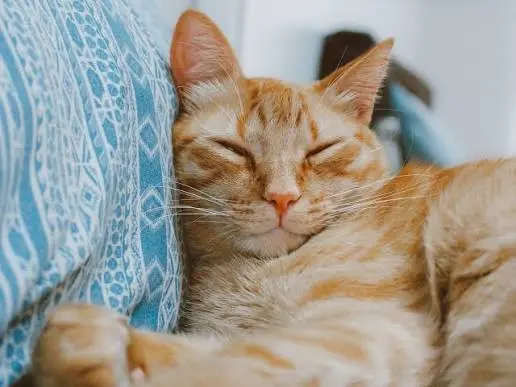
Cats may purr while they are resting or becoming sleepy.
A cat that is curled up in a warm, familiar location and quietly purring may simply be comfortable.
You may notice your cat purring while:
- Napping beside you
- Lying in a sunny window
- Sleeping on a soft blanket
- Resting on your bed
- Sitting comfortably in its favorite spot
PetMD lists drowsiness and resting in a warm, familiar environment among situations in which cats may purr.
The important thing is to observe whether your cat appears relaxed.
A peaceful sleeping cat with normal breathing and relaxed muscles is very different from a cat that is restless, hiding, or showing other unusual symptoms while purring.
Why Does My Cat Purr When It Eats?
Some cats purr around mealtimes.
You may hear your cat purring:
- While eating
- Just before food arrives
- After finishing a meal
- While waiting for treats
Purring around food can occur because the cat is experiencing a positive or rewarding situation.
Some cats may also purr because they have learned that certain behaviors get attention from their humans.
For example, your cat may begin purring and rubbing against your legs when you walk toward the kitchen because it has learned that this usually means food is coming.
In this case, the purr may be part of a larger communication pattern.
Why Does My Cat Purr When It Sees Me?
A cat may give a short purr when greeting a familiar person.
This can happen when you:
- Come home
- Enter a room
- Sit beside your cat
- Approach your cat calmly
Your cat may combine the purr with other greeting behaviors, such as walking toward you, raising its tail, rubbing against your legs, or gently touching you.
A friendly greeting purr can be brief rather than continuous.
Mother cats can also purr when approaching their kittens, showing that purring can have a social role as well.
So if your cat gives you a little purr when you walk through the door, it may be part of its way of saying hello.
Why Does My Cat Purr When It Is Anxious?
This is one of the most important things for cat owners to understand.
A purring cat is not always a happy cat.
Some cats purr when they are anxious or stressed.
Purring may potentially function as a self-soothing behavior during stressful situations.
For example, a cat may purr:
- During a veterinary examination
- After returning from a veterinary clinic
- During an unfamiliar situation
- While feeling nervous
- When trying to calm itself
If your cat is purring in a stressful situation, look at its entire body.
Signs of stress may include:
- Flattened or sideways ears
- A tense or hunched posture
- Hiding
- Dilated pupils
- Restlessness
- Tail held tightly against the body
PetMD notes that cats may purr during anxiety and stressful situations, so the sound should always be interpreted together with body language.
Can Cats Purr When They Are Scared?
Yes.
Some cats may purr while frightened.
This can be confusing because owners naturally associate purring with comfort.
Imagine taking your cat to a veterinary clinic.
Your cat may be nervous, sitting stiffly inside the carrier, yet still purring.
The purring does not necessarily mean your cat is enjoying the experience.
It may be part of the cat’s response to stress or an attempt to calm itself.
This is why looking only at the sound can lead to the wrong conclusion.
Always consider the environment and the rest of your cat’s body language.
Can Cats Purr When They Are Sick?
Yes.
Cats can sometimes purr when they are sick or experiencing pain.
This is one reason you should not automatically assume that purring means everything is fine.
A sick cat may also show other changes, such as:
- Hiding
- Reduced appetite
- Low energy
- Changes in grooming
- Unusual posture
- Changes in social behavior
- Difficulty moving
- Changes in normal vocalizations
PetMD specifically notes that cats can purr when they are ill or in pain.
The purr itself does not diagnose illness.
Instead, it is the combination of the purr with other changes that should get your attention.
How Can You Tell What a Cat Purr Means?
The easiest way is to look at the whole situation.
Ask yourself:
What is my cat doing?
Is your cat sleeping, eating, playing, hiding, or sitting quietly?
What does the body language look like?
Are the ears relaxed or flattened?
Are the eyes soft or wide?
Is the body loose or tense?
What is happening around the cat?
Is the cat in a familiar home environment or at a stressful veterinary clinic?
Is this normal for my cat?
You know your cat’s normal behavior better than anyone.
A sudden change can be more meaningful than a behavior your cat has displayed regularly for years.
For example:
Purring + relaxed body + kneading + closed eyes = likely contentment
while:
Purring + hiding + tense posture + reduced appetite = possible stress or illness
These are not medical diagnoses, but they show why context matters.
Is a Purring Cat Always Happy?
No.
This is one of the biggest myths about cat purr meaning.
Cats often purr when they are happy, but purring can also occur during anxiety, stress, discomfort, or illness.
That does not mean you should become worried every time your cat purrs.
Most everyday purring is perfectly normal.
The important point is simply not to use the purr as the only sign of your cat’s emotional or physical condition.
Look at the entire cat.
Their eyes, ears, posture, appetite, activity level, and normal habits all provide additional information.
Do Kittens Purr?
Yes.
Kittens can begin purring very early in life.
PetMD reports that kittens can purr as early as two days old.
Kittens may purr while nursing and may also use purring during interactions with their mother and littermates.
This early behavior shows that purring is not something cats develop only because humans pet them.
It is a natural part of feline communication and behavior.
As kittens grow into adults, they may continue to purr in many of the same situations, including during relaxation, greeting, food-related interactions, and attention-seeking.
Why Does My Cat Purr More Than Other Cats?
Cats vary greatly in how often and how loudly they purr.
Some cats are extremely vocal and may purr whenever you touch them.
Others may purr so quietly that you can only feel the vibration when you place a hand near their body.
Differences can be related to:
- Individual personality
- Communication habits
- Environment
- Social experiences
- Emotional state
There is no requirement for a healthy cat to purr a certain number of times each day.
What matters more is knowing what is normal for your individual cat.
If a cat that rarely purrs suddenly begins purring continuously while also showing unusual behavior, that change deserves more attention than simply comparing its purring frequency with another cat.
Can Humans Feel a Cat’s Purr?
Yes.
When a cat sits on your lap or chest, you may feel the vibration of its purr through its body.
The sensation can be especially noticeable when the cat is resting against you.
This is one reason many people find spending time with a purring cat relaxing.
A cat’s purr can create a quiet, repetitive sound and gentle vibration that many people find comforting.
Some health organizations have discussed possible effects of exposure to low-frequency purring sounds, but claims about specific medical healing effects should be treated cautiously because evidence is not strong enough to say that a cat’s purr can directly treat medical conditions.
Cat Purring at Night, Loud Purring, Self-Soothing and Health
Why Does My Cat Purr at Night?
Cats can purr at night for many of the same reasons they purr during the day.
Your cat may be comfortable, seeking attention, hungry, or simply interacting with you.
Some cats become more active during the evening and early morning because cats naturally have activity patterns that differ from humans.
If your cat jumps onto your bed at night, settles beside you, and begins quietly purring, it may simply be enjoying the warmth and companionship.
However, if nighttime purring is new and comes with unusual behavior, it is worth paying attention.
For example, a cat that suddenly starts pacing, hiding, vocalizing, or repeatedly changing sleeping positions while purring may not simply be relaxing.
Look at the complete behavior rather than assuming that the purr automatically means happiness.
Why Does My Cat Purr So Loudly?
Some cats naturally have louder purrs than others.
You may barely hear one cat purr, while another can sound like a tiny motor sitting beside you.
The volume can vary depending on the individual cat and the situation.
A cat may purr particularly loudly when it is:
- Being petted
- Sitting on your lap
- Waiting for food
- Seeking attention
- Relaxing
- Greeting you
A loud purr by itself does not necessarily indicate a problem.
What matters more is whether the purring is normal for your cat and whether there are other changes in behavior.
If your cat has always been a loud purrer and otherwise acts normally, the sound is likely just part of that cat’s individual communication style.
Why Does My Cat Purr When I Hold It?
If your cat relaxes in your arms and begins purring, it may be enjoying the contact.
Some cats like being held because they feel warm and secure against their owner’s body.
Others do not enjoy being picked up and may become tense or uncomfortable.
So don’t assume that purring automatically means your cat wants to be held longer.
Watch for signs such as:
- Relaxed muscles
- Soft eyes
- Forward or neutral ears
- Comfortable body posture
- Staying close voluntarily
If your cat becomes tense, struggles, flattens its ears, or tries to escape, give it space.
Cats can also purr when frightened or uncomfortable, so body language is important when interpreting the sound.
Why Does My Cat Purr and Rub Against Me?
Purring and rubbing often happen together during friendly interactions.
Your cat may approach you, purr, rub its face against your legs, and then walk around your feet.
This can be a combination of social interaction, scent marking, and attention-seeking.
Cats have scent glands around parts of their face and body.
When your cat rubs against you, it can leave its scent while also interacting socially with you.
The purring adds another form of communication.
So when your cat walks toward you purring and rubbing against your legs, it may be saying something like, “I want attention.”
It may also be asking for food, play, or simply enjoying being close to you.
Why Does My Cat Purr When It Wants Attention?
Some cats learn that purring gets a response from their humans.
If your cat purrs, walks toward you, and then receives petting, it may learn that this behavior is an effective way to start an interaction.
Attention-seeking purring can happen alongside:
- Rubbing
- Head-butting
- Kneading
- Meowing
- Following you
- Sitting close to you
For example, your cat may jump onto your desk while you are working and start purring loudly.
If you immediately stop working and pet your cat, your cat may learn that purring is a successful way to get your attention.
This does not necessarily mean the behavior is bad.
It is simply one way cats communicate with people.
Why Does My Cat Purr Before I Feed It?
Some cats begin purring when they know food is coming.
You may notice your cat following you toward the kitchen, rubbing against your legs, and purring while you prepare its meal.
The purring can become part of a learned routine.
Cats are excellent at recognizing patterns.
If the sound of a food container opening is regularly followed by a meal, your cat may become excited before the food even reaches the bowl.
The purring may therefore be connected to anticipation, attention-seeking, or positive excitement.
If your cat suddenly becomes extremely focused on food or its appetite changes dramatically, however, that is different and should be monitored.
Why Does My Cat Purr When It Kneads Me?
Purring and kneading are commonly seen together.
Kittens knead their mother’s belly while nursing, and they may purr during nursing.
Some cats continue this behavior into adulthood when they feel comfortable and relaxed.
An adult cat may knead:
- Your lap
- A blanket
- A pillow
- Your clothes
- Its own bed
If your cat purrs while kneading your lap, it may be showing comfort or engaging in a familiar behavior that began during kittenhood.
The only downside may be those tiny claws.
If kneading hurts, place a soft blanket between your cat’s paws and your skin rather than pushing the cat away harshly.
Why Does My Cat Purr When It Is Nervous?
Purring can sometimes be a form of self-soothing.
A nervous cat may purr during an unfamiliar or stressful situation.
For example, your cat may purr:
- In a carrier
- During a car ride
- At the veterinarian
- After returning home from the clinic
- During a stressful household event
The cat may be using the behavior as part of its coping response.
This is why a purring cat at the veterinarian should not automatically be interpreted as a relaxed cat.
Look at the rest of its body.
A nervous cat may have a tense posture, flattened or sideways ears, dilated pupils, hiding behavior, or other signs of stress.
Can Purring Calm a Cat?
Purring may have a self-soothing role for some cats.
When a cat is stressed, frightened, or uncomfortable, purring may occur as part of its coping behavior.
However, we should be careful about saying that purring definitely “calms” every cat.
Cats are individuals.
One cat may purr during stress, while another may hide or become very quiet.
So purring should be considered one possible coping behavior rather than a guaranteed sign that the cat is calming itself.
If your cat is showing obvious signs of distress, the goal should be to reduce the stressful situation rather than simply relying on the purring.
Does a Cat’s Purr Heal the Cat?
You may have heard the popular claim that a cat’s purr can heal its bones, muscles, or other injuries.
This idea comes from research and discussion about the frequencies associated with feline purring and their possible biological effects.
However, it is important not to turn this into a medical claim.
There is not enough evidence to say that a cat deliberately purrs in order to heal an injury or that purring can replace veterinary treatment.
A cat that is sick or injured still needs appropriate medical care.
If your cat is purring while showing signs of pain, weakness, reduced appetite, hiding, or unusual behavior, do not assume that the purring means it is healing itself.
Purring can occur during illness and pain as well.
Can a Cat’s Purr Help Humans?
Many people find the sound of a cat purring relaxing.
The gentle repetitive sound may create a calming environment, especially when the cat is sitting close to you.
Some health and pet-care sources have discussed possible connections between exposure to a cat’s purr and human relaxation or well-being.
However, claims that a cat’s purr can directly treat medical conditions should be treated cautiously.
A purring cat can certainly be part of a comforting relationship, but it should not be considered a medical treatment.
If spending time with your cat helps you relax after a stressful day, that is a perfectly reasonable benefit to enjoy without making unsupported health claims.
Does Cat Purring Have a Special Frequency?
Cat purring is a low-frequency vocalization.
The exact frequency can vary depending on the cat and the circumstances.
This has contributed to scientific interest in whether purring vibrations could have biological effects.
However, the existence of measurable vibrations does not automatically prove that they provide a medical healing effect.
This distinction is important when writing about cat purr meaning.
It is safe to say that purring produces vibrations and may serve different behavioral functions.
It is not accurate to promise that those vibrations will heal a person’s injury or cure a cat’s illness.
Why Does My Cat Purr When It Is Sick?
A sick cat may purr for several possible reasons.
It could be attempting to self-soothe, communicating a need for attention, or simply continuing a behavior that occurs in different emotional states.
The purr itself cannot tell you whether the cat is healthy.
Instead, watch for additional symptoms.
A cat that is sick or in pain may also:
- Hide more than usual
- Eat less
- Drink differently
- Groom less or excessively
- Become unusually quiet
- Change sleeping habits
- Avoid being touched
- Become restless
- Change its posture
- Show unusual vocalizations
Cats are often good at hiding illness, so subtle changes in normal behavior can be important.
Why Is My Cat Purring but Acting Strange?
This is a situation where context becomes especially important.
Suppose your cat normally sleeps on the sofa, eats normally, plays every evening, and occasionally purrs when you pet it.
Then one day you notice your cat hiding under the bed, refusing food, sitting hunched up, and purring continuously.
The purr itself should not reassure you that everything is fine.
The unusual behavior is the important part.
A sudden change in purring combined with other changes can justify contacting your veterinarian.
When Should You Worry About Your Cat’s Purring?
Occasional purring is normal.
You should pay more attention when the purring is new, unusually frequent, or accompanied by other concerning changes.
Contact your veterinarian if your cat is purring while also showing signs such as:
- Loss of appetite
- Significant lethargy
- Hiding
- Difficulty moving
- A hunched or tense posture
- Reluctance to be touched
- Repeated vomiting
- Breathing problems
- Sudden behavioral changes
The combination of symptoms matters more than the purr alone.
A cat that is eating, playing, grooming, sleeping normally, and behaving as usual while purring is very different from a cat that suddenly starts purring while appearing unwell.
Why Does My Cat Purr and Hide?
A cat that purrs while hiding may be stressed, frightened, uncomfortable, or unwell.
Hiding is an important clue.
Healthy cats can certainly choose to hide for quiet time, but a sudden increase in hiding behavior is different.
For example, if your cat normally sleeps on the sofa but suddenly spends the entire day underneath the bed while purring, check for other changes.
Has your cat:
- Stopped eating?
- Become less active?
- Changed its grooming?
- Started avoiding touch?
- Changed its litter box habits?
If several changes happen together, veterinary advice is appropriate.
Why Does My Cat Purr but Not Want to Be Touched?
Purring does not necessarily mean that your cat wants physical contact.
A cat may purr while feeling anxious or uncomfortable.
For example, your cat may sit near you and purr but move away when you try to touch it.
In that situation, respect the cat’s choice.
Do not force petting simply because the cat is purring.
Look for signs that your cat is actually enjoying interaction, such as approaching voluntarily, relaxing its body, rubbing against you, and remaining close.
Why Does My Cat Stop Purring Suddenly?
A cat may stop purring simply because its emotional state or activity has changed.
For example, your cat may stop purring when it hears a noise, notices a bird outside, or becomes interested in a toy.
That is completely normal.
However, if a cat that normally purrs frequently suddenly becomes withdrawn and quiet while also showing other behavioral changes, it is worth paying attention.
A change in vocal behavior can sometimes accompany illness, stress, or discomfort.
Your cat’s overall behavior is more important than whether it purrs every day.
Is Purring Different From Meowing?
Yes.
Purring is a low, vibrating sound that generally occurs during breathing.
Meowing is a different vocalization that cats commonly use when communicating with people.
Cats can use both sounds for different purposes.
A cat may purr while being petted and meow when it wants food.
Another cat may purr while resting and meow when greeting its owner.
There is no universal translation where one purr or one meow always means exactly the same thing.
Context matters for both sounds.
Do Cats Purr to Communicate With Humans?
Yes.
Cats can use purring as part of their communication with people.
A cat may purr while asking for attention, greeting you, enjoying petting, or interacting socially.
Over time, cats and their owners can develop individual communication patterns.
For example, you may learn that your cat makes a particular purr when it wants food.
Another purr may occur only when the cat is relaxing on your lap.
Learning your cat’s normal patterns can make it easier to recognize changes later.
Can Cats Control Their Purring?
Purring is considered a voluntary vocal behavior, meaning cats can produce it intentionally rather than it being simply an automatic sound like breathing.
This does not mean a cat consciously thinks, “I will now purr because I am happy.”
Instead, cats have the ability to produce the vocalization in different contexts.
That flexibility helps explain why the same behavior can occur during both pleasant and unpleasant situations.
Why Does My Cat Purr When It Sees Another Cat?
A cat may purr during a friendly social interaction.
Mother cats may purr when approaching their kittens, and cats may also use purring during interactions with other familiar cats.
But purring does not automatically mean two cats are comfortable with each other.
Look at their body language.
Relaxed bodies, normal ears, and friendly approaches suggest a different situation from flattened ears, staring, hissing, swatting, or tense postures.
Again, the sound is only one piece of the communication puzzle.
Why Does My Cat Purr in the Car?
A car ride can be stressful for many cats.
Some cats may purr during transportation as part of a stress or self-soothing response.
If your cat is purring inside its carrier while appearing tense, hiding its face, vocalizing unusually, or trying to escape, do not assume that it is enjoying the trip.
Reducing stress during transportation can help.
A secure carrier, familiar bedding, and calm handling may make the experience easier.
If your cat becomes extremely distressed during travel, discuss strategies with your veterinarian.
Why Does My Cat Purr at the Vet?
Veterinary visits can be stressful.
Some cats purr while being examined or after returning home from a veterinary clinic.
This can be a coping response rather than a sign that the cat is enjoying the examination.
This is particularly important because purring can sometimes make owners think their cat is completely relaxed.
Veterinarians consider purring alongside other body-language and physical signs when evaluating a cat.
Cat Purring and Body Language
The best way to understand cat purr meaning is to combine the sound with body language.
Purring + relaxed body
Usually suggests comfort or contentment.
Purring + kneading
Often associated with relaxation and a behavior carried from kittenhood.
Purring + rubbing
May indicate social interaction or attention-seeking.
Purring + hiding
May indicate stress, fear, discomfort, or illness.
Purring + tense posture
Needs more attention because the cat may not be comfortable.
Purring + reduced appetite
Should not be ignored, especially if the appetite change is sudden.
Purring + breathing difficulty
Needs prompt veterinary attention.
The goal is not to memorize one fixed meaning for every purr.
Instead, learn your own cat’s normal patterns and watch for changes.
Understanding Your Cat’s Purr, Purring Sounds, Changes and FAQs
Why Does My Cat Purr When I Talk to It?
Some cats respond to their owner’s voice with purring.
Your cat may look toward you, approach you, rub against you, or begin purring when you speak.
This can happen because your cat recognizes your voice and associates it with safety, attention, food, or companionship.
Cats can develop strong routines with their owners.
For example, if you normally talk to your cat while petting it in the evening, your voice may become part of that relaxing routine.
The purr is therefore best understood together with the cat’s other behavior.
Why Does My Cat Purr and Follow Me Everywhere?
A cat that follows you around while purring may be seeking companionship, attention, food, or interaction.
Some cats are naturally more social than others.
Your cat may follow you from the bedroom to the kitchen and then into another room because it has learned that being near you leads to something positive.
You might notice your cat:
- Purring
- Rubbing against your legs
- Looking up at you
- Sitting beside you
- Following you into different rooms
If your cat is otherwise relaxed and behaving normally, this is usually just part of its social behavior.
Some cats simply enjoy being close to their favorite person.
Why Does My Cat Purr and Stare at Me?
Purring and staring can have several meanings depending on the rest of your cat’s body language.
A relaxed cat may stare at you while purring because it is comfortable and interested in you.
It may also be waiting for something.
For example, your cat may stare at you from across the room while purring because it expects you to feed it or open the door.
Look at the eyes and body.
Soft eyes, relaxed ears, and a loose body suggest a very different situation from wide eyes, flattened ears, and a tense posture.
If your cat gives you a slow blink while calmly purring, that can be part of a relaxed social interaction.
Why Does My Cat Purr and Bite Me?
A cat can purr and bite during the same interaction.
This does not always mean that the cat is aggressive.
Some cats give gentle love bites while being petted.
Others may become overstimulated after too much touching and suddenly nip.
Pay attention to what happens immediately before the bite.
If your cat is relaxed, rubbing against you, and gives a very gentle nip without becoming tense, it may be a social behavior.
If the cat’s tail begins whipping, ears move backward, body becomes tense, and the bite becomes harder, your cat may be telling you to stop.
Purring does not cancel out the other body-language signals.
Why Does My Cat Purr When I Scratch Its Chin?
Many cats enjoy gentle scratching around the chin and cheeks.
These areas contain scent glands and are also commonly involved in friendly social interactions.
If your cat leans into your fingers, closes its eyes, relaxes its body, and purrs while you scratch its chin, it is likely enjoying the interaction.
However, individual cats have different preferences.
Some cats enjoy chin scratches but dislike being touched around the belly or tail.
The safest approach is to let your cat guide the interaction.
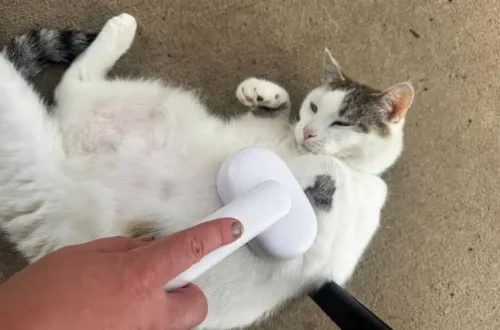
Why Does My Cat Purr When I Brush It?
Some cats enjoy grooming and may purr while being brushed.
A gentle brushing session can feel similar to social grooming for a cat that enjoys it.
Your cat may:
- Lean into the brush
- Purr
- Stay relaxed
- Rub against you
- Return for more brushing
Other cats may dislike brushing.
If your cat tries to escape, becomes tense, flattens its ears, or starts swishing its tail aggressively, stop and give it a break.
Purring is only one signal.
The entire body tells you whether your cat is actually comfortable.
Why Does My Cat Purr in My Bed?
Your bed may be warm, soft, familiar, and strongly associated with your scent.
A cat may choose to sleep or relax there because it feels safe.
If your cat curls up beside you and starts purring, the behavior is often associated with comfort and social closeness.
Cats frequently choose resting areas where they feel secure.
Your cat may also enjoy the warmth of your body.
If it has made your pillow its permanent sleeping location, you may simply have to accept that your cat has claimed the best spot.
Why Does My Cat Purr When It Is Grooming?
Cats may purr during grooming or other relaxed activities.
Grooming is an important part of normal feline behavior.
A cat that is calmly licking its fur while purring may simply be comfortable.
However, excessive grooming combined with purring can be different.
If your cat repeatedly licks one specific area, pulls out fur, develops bald patches, or appears uncomfortable, the behavior may indicate an underlying problem.
Changes in grooming habits should therefore be considered along with other signs.
Why Does My Cat Purr After Eating?
A cat may purr after eating because it is relaxed and satisfied.
Eating is a rewarding and familiar activity, and some cats naturally purr around mealtimes.
Your cat may finish its food, groom itself, settle into a comfortable position, and begin purring.
This is usually not concerning when the cat is otherwise healthy.
If your cat starts purring after meals while showing signs such as vomiting, drooling, difficulty swallowing, or obvious discomfort, however, that is different.
In that situation, speak with your veterinarian.
Why Does My Cat Purr in the Morning?
Your cat may purr in the morning because it wants attention, food, affection, or interaction.
Cats quickly learn daily routines.
If breakfast normally happens when you wake up, your cat may greet you at the same time every morning.
You might wake up to find your cat:
- Sitting beside your head
- Rubbing against you
- Purring
- Kneading the blanket
- Walking toward the kitchen
This can simply be your cat’s way of starting the day with you.
Why Does My Cat Purr After I Come Home?
A cat may purr when you return because it recognizes you and is responding to your presence.
Some cats become excited when their owner returns after being away.
They may combine purring with:
- Meowing
- Rubbing
- Following
- Tail-up greeting
- Head-butting
- Sitting close
The exact meaning varies between cats.
If your cat has developed this greeting routine, the purr may simply be one part of its social response.
Why Does My Cat Purr When I Am Sad?
Cats can become responsive to changes in their owner’s behavior.
If you are sitting quietly, crying, or behaving differently from normal, your cat may approach you or stay nearby.
A cat may purr during this interaction.
It is tempting to say that your cat understands exactly why you are sad, but we cannot know precisely what a cat understands emotionally.
What we can observe is that cats may respond to changes in human behavior and social interaction.
If your cat comes close and purrs while you are having a difficult day, you can simply enjoy the companionship without assuming a specific human-like explanation.
Why Does My Cat Purr When I Kiss It?
Some cats tolerate or enjoy gentle affection from their owners.
If your cat remains relaxed, stays close, and begins purring when you give it a gentle kiss, it may associate the interaction with positive attention.
Other cats dislike being kissed or having their faces approached closely.
If your cat turns its head away, moves backward, flattens its ears, or tries to leave, respect that signal.
The fact that a cat purrs sometimes does not mean it wants unlimited physical contact.
Why Does My Cat Purr but Not Meow?
Cats have individual communication styles.
Some cats meow frequently but rarely purr loudly.
Others may purr often while making relatively few other vocalizations.
Purring and meowing are different vocal behaviors, and one does not need to accompany the other.
A quiet cat can still communicate through:
- Body posture
- Tail movement
- Eye contact
- Facial expressions
- Ear position
- Rubbing
- Kneading
- Purring
If your cat has always been relatively quiet, that can simply be its personality.
A sudden change in vocal behavior is more important than the absolute amount of vocalization.
Why Does My Cat Purr but Have Its Ears Back?
This combination deserves closer attention.
A cat with its ears pulled backward or flattened may be uncomfortable, frightened, irritated, or defensive.
If the cat is also purring, do not assume that the purring means it is happy.
Look at the complete picture.
For example:
Purring + relaxed ears + soft eyes + loose body
is different from:
Purring + flattened ears + tense body + wide eyes.
The second combination may indicate stress or fear.
Give the cat space rather than forcing interaction.
Why Does My Cat Purr With Its Tail Flicking?
Tail movement can provide important information.
A gently moving or relaxed tail can occur during normal interaction.
But rapid or forceful tail flicking can indicate irritation or overstimulation.
If your cat is purring while you pet it and its tail suddenly starts whipping from side to side, this may be a signal that the interaction is becoming too much.
Some cats continue purring even when they are becoming overstimulated.
Learning these small signals can help prevent a gentle interaction from turning into a bite or scratch.
Why Does My Cat Purr and Stretch?
Cats often stretch after sleeping or resting.
If your cat stretches, relaxes, and begins purring, it may simply be comfortable and transitioning into another activity.
You may see this in the morning when your cat wakes up.
A cat may:
- Wake up.
- Stretch its front legs.
- Arch or extend its body.
- Start walking.
- Approach you while purring.
This is a normal combination of behaviors.
If stretching is accompanied by obvious stiffness, difficulty walking, or signs of pain, however, the situation should be evaluated differently.
Why Does My Cat Purr When It Is in a Carrier?
A carrier can be stressful for many cats.
Some cats may purr during transportation even when they are nervous.
Other cats may become very quiet and hide.
If your cat is purring in its carrier but also showing signs of stress, do not interpret the purring as proof that it is comfortable.
Try to make the carrier more familiar by allowing your cat to spend time around it before travel.
A familiar blanket or bedding can also make the carrier feel less unfamiliar.
If your cat experiences severe travel anxiety, ask your veterinarian about appropriate ways to reduce travel stress.
Why Does My Cat Purr After a Scary Experience?
A cat may purr after something frightening has happened.
For example, a loud noise may cause your cat to hide under the bed.
After the immediate threat has passed, your cat may remain there and purr.
The purring may be part of a self-soothing or coping response.
Give your cat time to calm down.
Avoid dragging it out of its hiding place unless there is an immediate safety concern.
A quiet, predictable environment can help the cat return to normal behavior.
Can Purring Be a Sign of Pain?
Yes, it can occur alongside pain, although purring alone does not prove that a cat is in pain.
This is why cat purring meaning cannot be determined from sound alone.
If your cat is purring while also:
- Sitting hunched up
- Avoiding movement
- Hiding
- Refusing food
- Reacting negatively to touch
- Breathing differently
- Showing sudden behavioral changes
you should take the additional signs seriously.
Cats can hide pain, so unusual behavior may be one of the earliest clues that something is wrong.
Can Purring Mean My Cat Wants Something?
Yes.
Cats can use purring as part of attention-seeking behavior.
Your cat may purr because it wants:
- Food
- Petting
- Play
- Access to a room
- Your attention
- Companionship
You may eventually recognize different patterns in your own cat.
For example, your cat might purr softly when asking for petting but become more persistent around dinner time.
Cats can learn which behaviors get results from their humans.
Does Every Cat Purr?
Most domestic cats can purr, but individual cats differ significantly in how often and how loudly they do it.
Some cats have a very noticeable purr.
Others produce such a quiet purr that you can mainly feel the vibration.
A cat that rarely purrs is not automatically unhealthy.
The important thing is what is normal for that particular cat.
If your cat has never been a frequent purrer but otherwise eats, plays, sleeps, grooms, and behaves normally, there is not necessarily a problem.
Why Does My Cat Purr More Than Usual?
An increase in purring can happen for ordinary reasons.
Your cat may be:
- Getting more attention
- Feeling comfortable
- Experiencing a change in routine
- Seeking food
- Spending more time with you
- Becoming more social
However, a sudden increase in purring accompanied by unusual behavior should not be ignored.
For example, if your cat starts purring constantly while hiding, eating less, or avoiding movement, the change deserves veterinary attention.
The key is not simply how much your cat purrs.
It is whether the purring represents a meaningful change from your cat’s normal behavior.
Why Does My Cat Purr Less Than Before?
Cats can change their behavior for many reasons.
A cat may purr less because:
- Its routine changed
- It is stressed
- Its environment changed
- It is interacting differently with people
- It is experiencing discomfort
- It is getting older
If the change is gradual and your cat otherwise behaves normally, it may simply be a change in communication style.
But if reduced purring occurs alongside appetite loss, hiding, lethargy, pain, or other unusual symptoms, speak with a veterinarian.
Can Purring Help You Bond With Your Cat?
Purring can become part of a positive social routine between a cat and its owner.
When your cat voluntarily sits beside you, relaxes, and purrs, the interaction can strengthen your familiarity with each other.
You also learn to recognize your cat’s individual communication style.
Over time, you may become familiar with:
- Its normal purr
- Its attention-seeking purr
- Its relaxed body language
- Its stress signals
- Its preferred type of touch
This is one reason observing your cat’s behavior is so useful.
You are not simply listening to a sound.
You are learning how your individual cat communicates.
Cat Purring: Frequently Asked Questions
Why do cats purr?
Cats may purr when they are relaxed, content, greeting someone, seeking attention, or interacting socially. They can also purr during stress, anxiety, discomfort, or illness.
What does a cat purr mean?
The meaning depends on the situation. A relaxed cat may purr because it is comfortable, while a stressed cat may purr as part of a coping response.
Do cats purr when they are happy?
Yes. Contentment and relaxation are common reasons cats purr, especially while being gently petted or resting.
Can cats purr when they are sad?
Cats may purr during stressful or uncomfortable situations, so purring does not always represent happiness.
Why does my cat purr when I pet it?
Your cat may be enjoying the interaction. If its body is relaxed and it voluntarily stays close, the purr is likely part of a positive social interaction.
Why does my cat purr and knead?
Purring and kneading often occur together because kneading is a behavior that began during kittenhood and may continue when adult cats feel comfortable.
Why does my cat purr at night?
It may be relaxed, seeking attention, hungry, or interacting with you. Sudden nighttime purring combined with unusual behavior should be investigated.
Why does my cat purr loudly?
Some cats naturally have louder purrs. Loudness alone is not usually a sign of illness.
Can cats purr when they are in pain?
Yes. Cats can purr while sick or experiencing pain, so a purr should not be used as proof that a cat is healthy.
How can I tell if my cat’s purr is a happy purr?
Look for relaxed body language, soft eyes, normal ears, comfortable posture, and other positive behaviors such as kneading or rubbing.
Why does my cat purr but hide?
Purring while hiding can occur with stress, fear, discomfort, or illness. If hiding is sudden or accompanied by other changes, contact a veterinarian.
Why does my cat purr and bite me?
Some cats give gentle love bites while relaxed, while others bite because they become overstimulated. Watch for changes in tail, ears, posture, and facial expression.
Why does my cat purr when it sees me?
Your cat may be greeting you or seeking attention. Purring may be combined with rubbing, following, or sitting close.
Do kittens purr?
Yes. Kittens can purr very early in life and may purr during interactions with their mother.
Does a cat’s purr heal humans?
There is interest in the possible effects of low-frequency vibrations, but there is not enough evidence to claim that cat purring directly heals human medical conditions.
Does a cat’s purr heal cats?
Purring may have a self-soothing role, but it should not be considered a substitute for veterinary treatment when a cat is sick or injured.
Should I worry if my cat suddenly purrs a lot?
Not necessarily, but a sudden increase in purring combined with hiding, appetite loss, lethargy, pain, or other unusual behavior deserves attention.
Should I worry if my cat stops purring?
A temporary change is not necessarily concerning. If reduced purring occurs with other behavioral or physical changes, veterinary advice may be appropriate.
Why does my cat purr when I hold it?
Your cat may feel comfortable and secure while being held. However, watch for signs that it wants to be put down because cats can also purr during stress.
Why does my cat purr before eating?
Purring can be part of food-related excitement, anticipation, or attention-seeking behavior.
Can cats control when they purr?
Cats can produce purring voluntarily in different situations, which helps explain why purring can occur during both pleasant and stressful experiences.
Is purring normal for cats?
Yes. Purring is a normal feline behavior. The important thing is to understand it within the context of your cat’s overall behavior.