






Cat Paws: Everything You Need to Know About Your Cat’s Paws
Your cat’s paws do much more than help it walk.
They help your cat run, jump, climb, scratch, balance, explore, communicate, and even gather information about its surroundings. If you have ever watched your cat quietly walk across a room, suddenly jump onto a high shelf, or gently touch your face with one paw, you have already seen how useful and complex cat paws really are.
Many cat owners also have questions about their cat’s paws.
You may wonder:
How many toes do cats have?
What are toe beans?
Why are cat paws so soft?
Why does my cat have an extra toe?
What does a cat paw print look like?
Why does my cat keep touching me with its paw?
Understanding basic paw anatomy can help you appreciate how your cat moves and behaves. It can also make it easier to notice changes such as swelling, cuts, cracked paw pads, or other problems that may need attention.
A cat’s paw may look small and simple from the outside, but it contains several important structures that work together every time your cat takes a step.
A cat’s nose can reveal a lot about its health and senses, so check out our Cat Nose guide to learn more about its appearance, function, and common concerns.
What Are Cat Paws?
Cat paws are specialized structures located at the end of your cat’s legs.
They are designed to support movement while also helping with balance, hunting behavior, climbing, scratching, and communication.
A cat paw contains several important parts, including:
- Toes
- Paw pads
- Claws
- Bones
- Joints
- Muscles
- Nerves
These structures work together to allow your cat to move with impressive control.
For example, your cat may quietly walk across the floor and then suddenly jump onto a table.
Its paws help absorb some of the impact when landing while also helping the cat maintain balance.
Cats are also known for walking quietly.
The soft paw pads help cushion their steps, allowing them to move more silently than many other animals.
This ability was especially useful for their wild ancestors when approaching prey.
Even though your house cat may now use its stealth skills to sneak toward a toy or surprise your sibling from behind the sofa, the basic paw structure still reflects those natural abilities.
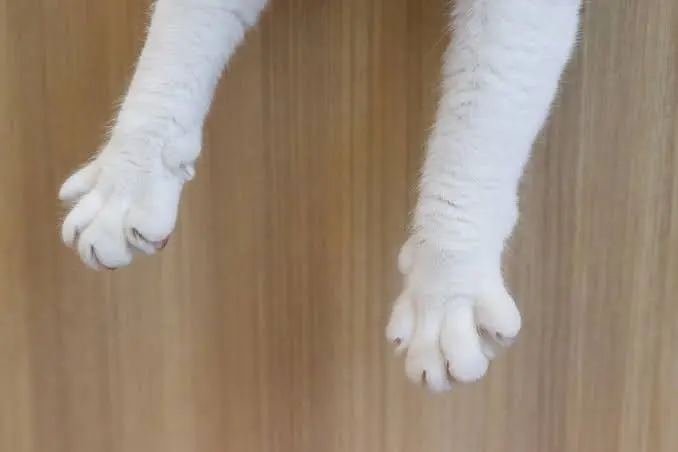
Basic Cat Paws Anatomy
Understanding cat paws anatomy can make the rest of your cat’s behavior easier to understand.
A paw is not simply a soft pad with claws attached.
It is a complex structure containing bones, joints, soft tissue, nerves, and protective pads.
The visible parts of a cat paw include:
- Toes
- Digital paw pads
- A larger central pad
- Claws
- Fur around and between the toes
Cats also have a small additional pad on their front legs called the carpal pad, which we will discuss later.
The front and back paws are also slightly different from each other.
This difference helps support the different roles each set of paws plays during movement.
What Are Paw Pads?
Paw pads are the soft but durable areas found on the bottom of a cat’s feet.
They help cushion the paws when your cat:
- Walks
- Runs
- Jumps
- Lands
- Climbs
The pads also help protect the structures inside the paw from everyday pressure.
Imagine your cat jumping down from a chair.
Without any cushioning, the impact would place more direct pressure on the bones and joints.
The paw pads help absorb some of that force.
However, “soft” does not mean that paw pads are weak.
They are designed to handle regular movement and contact with different surfaces.
The outer surface can also feel slightly rougher than you might expect.
This helps provide protection and grip.
What Are Toe Beans?
The small individual pads underneath a cat’s toes are often affectionately called toe beans.
The nickname comes from their rounded shape.
When you look at the bottom of your cat’s paw, the small pads may resemble tiny beans.
Each toe has its own small digital pad.
Behind them is a larger central pad.
Together, these pads help support your cat while walking and moving.
Toe beans are not just cute.
They are part of the paw’s functional design.
They help provide cushioning and contact with the surface beneath your cat.
If your cat allows you to look at its paws, you may notice that the toe beans can have different colors depending on the cat.
Some may be:
- Pink
- Black
- Brown
- Gray
- Spotted or multicolored
The color of the paw pads is often related to the cat’s natural pigmentation.
We will discuss paw pad colors in more detail in Part 2.
Why Are Cat Paws So Soft?
One reason cat paws feel soft is because of the padded tissue on the bottom of the feet.
These pads help cushion the impact created by walking, running, and jumping.
Think about a cat jumping from your bed to the floor.
It may land much more quietly than you expect.
The combination of paw pads, flexible joints, and controlled movement helps absorb the impact.
The soft pads also help cats move quietly.
This is one reason a cat can sometimes walk into a room without you hearing it.
You may be sitting peacefully, completely convinced that you are alone.
Then suddenly, you turn around and discover your cat sitting behind you.
The paws have done their job.
How Many Toes Do Cats Have?
A typical cat usually has 18 toes.
Most cats have:
- Five toes on each front paw
- Four toes on each back paw
This means:
5 + 5 + 4 + 4 = 18 toes
The extra toe on the front paw is located higher than the other toes.
It is sometimes compared to a human thumb, although it does not function exactly like one.
This toe is commonly called the dewclaw.
The dewclaw can help with activities that involve gripping or stabilizing.
However, not every cat has exactly 18 toes.
Some cats are born with additional toes.
These cats are known as polydactyl cats, and we will explore them later in the article.
Front Cat Paws vs. Back Cat Paws
Your cat’s front and back paws are not identical.
The front paws usually have five toes, while the back paws usually have four toes.
The front paws also have the carpal pad and are often used more actively for certain behaviors.
Your cat may use its front paws to:
- Grab toys
- Hold objects
- Touch you
- Scratch
- Climb
- Pull objects closer
For example, when your cat catches a toy and holds it close, the front paws may work almost like hands.
The back paws have a different role during movement.
They provide powerful support for:
- Running
- Jumping
- Pushing off the ground
- Balancing
If your cat prepares to jump onto a high surface, you may notice it lower its body before pushing upward.
The back legs and paws help generate much of that powerful movement.
What Is the Carpal Pad?
The carpal pad is a small additional pad found on the front legs.
It is located slightly higher than the main paw pads, around the area that might look somewhat like the cat’s wrist.
Unlike the toe beans, the carpal pad does not normally touch the ground during regular walking.
It can provide additional traction and support during certain movements.
For example, when a cat jumps, climbs, or moves quickly, the carpal pad may help with grip and stability.
If you gently look at your cat’s front leg, you may notice this small pad above the main paw.
There is no matching carpal pad in the same position on the back paws.
This is one of the differences between front and back cat paws.
Why Do Some Cats Have Extra Toes?
Some cats are born with more toes than the usual number.
This condition is called polydactyly.
A cat with extra toes is known as a polydactyl cat.
The extra toes are usually the result of a genetic variation.
A polydactyl cat may have extra toes on:
- The Front paws
- The Back paws
- Both front and back paws
Some cats may have paws that appear wider than usual because of the additional toes.
These cats are sometimes called “mitten cats” because their paws can look as though they are wearing tiny mittens.
Extra toes are not automatically a problem.
However, cats with additional toes may need careful claw monitoring because claws on unusual or extra digits can sometimes require attention if they do not wear down naturally.
Regular paw checks can help you notice overgrown claws or debris around the toes.
Are Extra Toes Normal in Cats?
Yes, some cats are naturally born with extra toes.
Polydactyly is a naturally occurring genetic trait.
A cat does not become polydactyl because it has an injury or because the paw has changed over time.
The additional toes are present from birth.
However, it is important to distinguish naturally occurring extra toes from swelling or an abnormal growth.
If your cat normally has a certain number of toes and you suddenly notice a new lump, swelling, or unusual shape, that is not the same as having been born with extra toes.
In that situation, veterinary advice may be appropriate.
Knowing what your cat’s paws normally look like makes unusual changes easier to identify.
Why Do Cats Use Their Paws Like Hands?
Cats cannot hold objects exactly the way humans do, but their front paws are surprisingly useful.
Your cat may use a paw to:
- Pull a toy closer
- Touch your face
- Hold food or an object
- Explore something unfamiliar
- Tap you for attention
For example, you may be sitting on the sofa when your cat reaches out and gently places one paw on your arm.
This may be a way of seeking attention, interacting with you, or simply exploring.
Cats also use their paws when playing.
A toy may be caught, pushed, pulled, or held between the front paws.
This combination of movement, claws, and flexibility gives the paws an important role beyond simple walking.
Cat Paw Pads: Colors, Sensitivity, Claws and Cat Paw Behavior
What Color Are Cat Paw Pads?
Cat paws pads can come in several different colors.
You may see paw pads that are:
- Pink
- Black
- Brown
- Gray
- Spotted
- Multicolored
The color of a cat’s paw pads is generally connected to its natural pigmentation.
For example, a cat with light-colored fur may have pink paw pads, while a darker-colored cat may have dark paw pads.
A multicolored cat may also have a mixture of colors.
You might see one pink toe bean beside a dark one.
This can be completely normal.
Think of paw pad color as being similar to other natural pigmentation on a cat’s body.
The color itself does not determine whether the paw is healthy.
What matters more is whether there has been a sudden or unusual change along with symptoms such as swelling, sores, bleeding, or discomfort.
Why Does My Cat Have Pink and Black Paw Pads?
Different colors on the same paw can be normal.
Some cats naturally have mixed pigmentation.
For example, a cat may have:
- Mostly pink paw pads
- Mostly black paw pads
- Pink and black spots
- Different colored pads on different paws
A calico, tortoiseshell, or other multicolored cat may have particularly varied paw pad colors.
You may notice that the pattern of the paw pads matches the cat’s overall pigmentation.
There is no rule saying that every toe bean must be the same color.
Your cat can have a very fashionable collection of mismatched toe beans.
The important thing is to become familiar with your cat’s normal appearance.
If an area suddenly changes, develops a sore, or becomes swollen, it is worth paying closer attention.
Do Cats Sweat Through Their Paws?
Cats do have sweat glands associated with their paw pads.
This means a cat’s paws may sometimes leave slightly damp marks on a surface.
Sweating is not the main way cats regulate their body temperature.
Cats primarily manage heat in other ways, including behavior changes and grooming.
However, you may occasionally notice damp paw prints.
This can sometimes happen when a cat is:
- Warm
- Nervous
- Stressed
- Excited
For example, a nervous cat visiting a veterinary clinic may occasionally leave slightly damp paw marks while waiting.
This does not automatically mean something is wrong.
However, excessive sweating or other unusual symptoms should always be considered alongside your cat’s overall condition.
Why Are Cat Paws So Sensitive?
Cat paws contain many nerve endings, making them important sensory structures.
Your cat can gather information through its paws when walking or touching different surfaces.
The paws can help detect:
- Texture
- Pressure
- Vibration
- Surface changes
This sensitivity is useful for movement and exploring the environment.
However, it also explains why many cats do not enjoy having their paws held for long periods.
Imagine someone repeatedly grabbing your fingers while you are trying to relax.
You might eventually decide that enough is enough.
Your cat may feel the same way about unnecessary paw handling.
Some cats tolerate paw touching better than others.
The best approach is to introduce gentle handling gradually, especially when the cat is young.
Why Does My Cat Pull Its Paw Away?
Your cat may pull its paw away simply because paws are sensitive.
This behavior does not automatically mean that the paw is injured.
Your cat may simply dislike having its toes touched.
However, repeated pulling away from one particular paw can sometimes suggest discomfort.
Pay attention if your cat:
- Pulls away only when one paw is touched
- Licks one paw repeatedly
- Limping or avoids putting weight on the paw
- Has visible swelling
- Has a cut or foreign object between the toes
For example, if your cat normally allows gentle paw handling but suddenly reacts strongly when you touch its front left paw, it may be worth checking for an obvious problem.
Do not force the paw into a position if your cat appears painful or highly stressed.
Cat Claws: How Do They Work?
A cat’s claws are an important part of its paw anatomy.
Claws help cats:
- Climb
- Scratch
- Grip surfaces
- Catch objects
- Defend themselves
- Stretch
Most cat claws are retractable.
This means the claws can be extended when needed and kept partially protected when the cat is relaxed.
When your cat walks normally, the claws are usually not constantly scraping against the ground.
This helps keep them sharp.
You may see the claws extend when your cat:
- Scratches a scratching post
- Climbs
- Plays
- Stretches
- Grabs a toy
Claws are attached to the bones of the toes.
This is important because declawing is not the same as simply trimming the nails.
Routine claw trimming only removes the sharp tip, while declawing involves surgical removal of part of the toe and is a very different procedure.
Why Do Cats Have Retractable Claws?
Retractable claws provide cats with several advantages.
When the claws are not needed, they can remain partially protected.
When a cat needs grip, the claws can extend.
For example, your cat may walk quietly across a smooth floor without its claws clicking against the surface.
But when it jumps onto a climbing structure, the claws can help provide additional grip.
This design also supports scratching and climbing behavior.
Cats are naturally built to use their paws and claws in different ways depending on what they are doing.
Why Do Cats Scratch?
Scratching is normal cat behavior.
Cats may scratch to:
- Maintain their claws
- Stretch their bodies
- Mark an area
- Exercise natural behavior
- Provide visual and scent-related signals
This is why simply telling a cat, “Please stop scratching the sofa,” may not solve the problem.
The cat still has a natural need to scratch.
A better approach is to provide appropriate scratching surfaces.
These may include:
- Vertical scratching posts
- Horizontal scratching boards
- Different textures
- Stable scratching furniture
Placement also matters.
If your cat always scratches one particular area, placing an appropriate scratching surface nearby may help redirect the behavior.
Why Do Cats Knead With Their Paws?
Kneading is the behavior commonly known as making biscuits.
A cat may repeatedly push its front paws against:
- A blanket
- Your lap
- A pillow
- A soft bed
Many cats knead when they feel relaxed or comfortable.
The behavior begins early in life when kittens knead around their mother while nursing.
Some cats continue the behavior into adulthood.
For example, your cat may jump onto your lap, begin purring, and slowly push its paws in and out against your legs.
This often happens when the cat appears comfortable and content.
However, cats may knead for different reasons, and the behavior can also be connected to comfort, stretching, or natural scent-related communication.
So, when your cat starts making biscuits on your favorite blanket, it may simply be enjoying itself.
Your blanket has now been promoted to a bakery.
Why Does My Cat Put Its Paw on Me?
A cat may place its paw on you for several reasons.
It may be:
- Seeking attention
- Asking for interaction
- Exploring
- Maintaining contact
- Communicating that it wants something
The meaning depends on the situation.
For example, if your cat gently taps your arm and then looks toward its food bowl, the message may be quite clear.
On the other hand, a cat that places one paw on you while resting may simply be enjoying physical contact.
Look at the rest of your cat’s body language.
A relaxed cat with soft eyes and a comfortable posture may be behaving very differently from a tense cat with flattened ears.
The paw movement alone does not always tell the whole story.
Why Does My Cat Touch My Face With Its Paw?
Cats sometimes reach toward a person’s face with one paw.
This may happen during:
- Play
- Attention-seeking
- Exploration
- Relaxed interaction
Some cats are simply more physically interactive than others.
If the claws remain relaxed and the cat’s body language is calm, the touch may be gentle social behavior.
However, avoid encouraging rough play with your hands or face.
If your cat begins using claws or biting during play, calmly redirect the interaction toward an appropriate toy.
Your face is not designed to be a wrestling toy.
Why Do Cats Cover Their Faces With Their Paws?
You may have seen your cat sleeping with one or both paws over its face.
This adorable position can happen for several simple reasons.
Your cat may be:
- Blocking light
- Staying warm
- Resting comfortably
- Protecting its face while sleeping
Cats can sleep in many unusual positions.
If the cat appears relaxed and is otherwise behaving normally, covering its face with a paw is usually just part of its preferred sleeping position.
For example, a cat sleeping near a bright window may place a paw over its eyes.
It may look like your cat is refusing to wake up and deal with the world.
Honestly, we can all understand that feeling.
Why Do Cats Stretch Their Paws?
Cats often stretch their legs and paws after resting.
Stretching helps move the muscles and joints after a period of inactivity.
You may notice your cat:
- Extending the front paws forward
- Spreading the toes
- Extending the claws
- Stretching the back legs
A cat may also stretch against a scratching post.
This combines stretching with normal scratching behavior.
When your cat stretches and spreads its toes, you may get a good look at the claws.
This can sometimes help you notice whether a claw is becoming unusually long or curved.
Regular observation is useful because overgrown claws can sometimes cause discomfort or grow toward the paw pad.
Why Does My Cat Spread Its Toes?
Cats may spread their toes during stretching, movement, or when preparing to use their claws.
Spreading the toes can help the cat:
- Adjust its grip
- Extend the claws
- Maintain stability
- Stretch the paw muscles
You may notice this when your cat is preparing to jump or when it grips a scratching surface.
The movement is part of the natural flexibility of cat paws.
What Does a Cat Paw Print Look Like?
A cat paw print usually has a distinctive shape made up of the central paw pad and the individual toe impressions.
A typical print often shows:
- Four toe impressions
- One larger central pad
- A generally rounded shape
The exact appearance can vary depending on the surface.
A clear print in soft mud may look very different from a faint print on a dusty floor.
The front and back paws can also leave slightly different impressions.
A cat’s front paws are generally broader and rounder than the back paws, while the back paws may appear slightly narrower or more oval.
The size of the cat paw print will also depend on the individual cat.
A large cat will naturally leave a different-sized print than a small kitten.
Cat Paw Print vs. Dog Paw Print
At first glance, cat and dog paw prints can look similar.
Both usually show toes and a central pad.
However, there are some general differences.
A cat paw print often appears:
- More rounded
- Compact
- Smooth around the edges
- Without obvious claw marks
A dog paw print may appear more oval or elongated.
Claw marks are also more commonly visible in many dog prints.
This difference happens because cats normally walk with their claws retracted.
Of course, tracks are not always perfectly clear.
The surface, the animal’s movement, and the position of the paw can all affect what the print looks like.
So, one blurry print is not always enough to confidently identify the animal.
Why Are Claw Marks Usually Missing From a Cat Paw Print?
Most cats have retractable claws.
When walking normally, the claws are usually pulled back rather than constantly touching the ground.
Because of this, a typical cat paw print may not show visible claw marks.
However, claw marks can sometimes appear if:
- The cat is running
- The cat is climbing
- The cat is slipping
- The claws are extended
- The claws are unusually long
For example, if a cat suddenly runs across soft mud, the claws may extend for extra grip and leave visible marks.
So, the absence of claw marks can be a helpful clue when identifying a cat track, but it is not an absolute rule.
How to Check Your Cat’s Paws Safely
Checking your cat’s paws occasionally can help you become familiar with what is normal.
Choose a time when your cat is relaxed.
You can gently hold one paw for a few seconds and look for obvious changes.
Check:
- Paw pads
- Between the toes
- Claws
- Swelling
- Cuts
- Dirt or debris
- Changes in color
- Signs of discomfort
Do not force your cat to stay still.
If your cat pulls away or becomes stressed, stop and try again later.
A quick, calm check is more useful than turning paw care into a daily argument.
You may find it easiest to briefly check one paw at a time while your cat is resting beside you.
Why Does My Cat Have Dry Paw Pads?
A cat’s paw pads can sometimes feel dry or slightly rough.
This can happen because the pads regularly come into contact with different surfaces.
Indoor and outdoor conditions may also affect how the pads feel.
A mildly rough paw pad does not automatically mean there is a problem.
However, pay attention if you notice:
- Deep cracks
- Bleeding
- Sores
- Swelling
- Significant peeling
- Pain when walking
Do not apply random human creams or lotions to your cat’s paws.
Cats groom themselves and may lick substances from their paw pads.
If the pads appear persistently dry, cracked, or painful, ask a veterinarian which products are safe and appropriate.
What Causes Cracked Cat Paw Pads?
Cracked paw pads can happen for different reasons.
The exact cause is not always obvious from appearance alone.
Possible factors may include:
- Dryness
- Contact with irritating surfaces
- Injury
- Environmental conditions
- An underlying health issue
Minor roughness may be different from deep or painful cracks.
For example, a slightly rough paw pad in an active cat may not be as concerning as a paw that is cracked, bleeding, and causing the cat to limp.
Look at your cat’s overall behavior.
If the cat walks normally and does not react when the paw is touched, the situation may be different from a cat that repeatedly lifts the paw or refuses to put weight on it.
Persistent or severe cracking should be examined by a veterinarian.
Cuts and Injuries on Cat Paws
Cats can injure their paws while walking, climbing, jumping, or stepping on something sharp.
Possible injuries include:
- Small cuts
- Scratches
- Punctures
- Torn paw pads
- Injuries between the toes
If you notice a small injury, avoid repeatedly touching or squeezing the area.
Do not use harsh chemicals or human medications unless a veterinarian has advised you to do so.
More serious injuries may involve:
- Heavy bleeding
- A deep cut
- A torn pad
- Significant swelling
- Inability to walk normally
These situations require veterinary advice.
If your cat is bleeding heavily or appears seriously injured, seek veterinary care promptly.
What Should I Do If Something Is Stuck in My Cat’s Paw?
Sometimes debris may become trapped between the toes or around the paw.
You may notice your cat:
- Licking one paw repeatedly
- Holding the paw up
- Limping
- Chewing between the toes
If you can clearly see a loose piece of dirt or other surface debris and your cat allows gentle handling, you may be able to carefully remove it without forcing the paw.
However, do not dig deeply between the toes.
Do not attempt to remove an object that is embedded in the paw.
A deeply embedded object, severe pain, swelling, or bleeding should be evaluated by a veterinarian.
Trying to force out an embedded object can cause additional damage.
Why Is My Cat Limping?
Limping can happen when there is discomfort or injury somewhere in the leg or paw.
The cause may be minor or more serious.
Possible reasons can include:
- A cut
- Something stuck in the paw
- A damaged claw
- Swelling
- Injury to the leg
- Joint or muscle problems
A limp does not always mean the problem is visible on the paw.
You may carefully observe the paw and leg, but avoid bending or manipulating the limb if your cat appears painful.
Contact a veterinarian if the limp is severe, continues, gets worse, or is accompanied by swelling, bleeding, or an inability to bear weight.
Why Does My Cat Keep Licking Its Paw?
Cats normally groom their paws.
Occasional licking is part of regular self-care.
However, repeated attention to one specific paw can sometimes suggest that something is irritating or uncomfortable.
Check for visible:
- Cuts
- Swelling
- Debris
- Broken claws
- Changes between the toes
For example, if your cat spends a few minutes grooming all four paws, that may be normal.
But if it repeatedly licks only the same front paw throughout the day, there may be something worth investigating.
Do not assume excessive licking is simply a cleaning habit if it continues.
A veterinarian can help identify the cause when there is persistent licking or discomfort.
Overgrown Cat Claws
Cat claws can continue growing.
Some cats naturally wear their claws down through scratching and activity, while others may need regular trimming.
An overgrown claw may become:
- Long
- Curved
- Sharp
- Difficult to retract
In some cases, a severely overgrown claw can curve toward or into the paw pad, causing pain and injury.
Older cats or cats with limited activity may be more likely to need regular claw checks.
Look at the claws occasionally, especially the dewclaws.
Because dewclaws do not always make contact with the ground in the same way as other claws, they may not wear down naturally.
If you are unsure how to trim your cat’s claws safely, ask a veterinarian or qualified veterinary professional to demonstrate the correct method.
How Often Should You Check Cat Paws?
You do not need to perform a detailed paw inspection every day.
However, occasional checks can help you notice changes early.
A simple routine might include checking your cat’s paws when:
- Grooming your cat
- Trimming claws
- Noticing limping
- Seeing excessive paw licking
- Finding dirt or debris
- Observing a change in walking behavior
The goal is to know what your cat’s normal paws look like.
When you know the usual appearance of the pads, toes, and claws, it becomes easier to notice something unusual.
When Should You Contact a Veterinarian About Cat Paws?
Contact a veterinarian if you notice:
- Persistent limping
- Significant swelling
- Heavy or ongoing bleeding
- A deep cut
- A torn paw pad
- An embedded object
- A claw growing into the paw pad
- Persistent excessive paw licking
- Signs of severe pain
- Inability or reluctance to put weight on a paw
Do not wait for a routine appointment if your cat appears severely injured or is unable to walk normally.
A paw problem can sometimes worsen if left untreated.
Early attention may help prevent additional discomfort or complications.
Common Myths About Cat Paws
Myth: All Cats Have Exactly 18 Toes
Not always.
Most cats have 18 toes, but polydactyl cats are naturally born with extra toes.
Myth: Pink Paw Pads Are Healthier Than Dark Paw Pads
False.
Paw pad color is generally related to natural pigmentation.
Pink, black, brown, gray, or mixed colors can all be normal.
Myth: Cats Do Not Need Their Claws Checked
False.
Claws can become overgrown, damaged, or curved.
Regular observation is especially important for cats whose claws do not wear down naturally.
Myth: A Cat Licking Its Paw Always Means Something Is Wrong
False.
Cats normally groom their paws.
The concern is repeated or excessive licking of one particular paw, especially when combined with limping, swelling, or visible injury.
Myth: You Can Use Any Lotion on Dry Cat Paws
False.
Cats may lick substances from their paws, so human lotions or random products may not be safe.
Ask a veterinarian before applying products to cracked or irritated paw pads.
Frequently Asked Questions About Cat Paws
How many toes do cats have?
Most cats have 18 toes: five on each front paw and four on each back paw. Some polydactyl cats naturally have extra toes.
What are toe beans?
Toe beans are the small rounded paw pads underneath a cat’s toes. They help provide cushioning and contact with the surface.
Why are cat paws so soft?
Cat paws contain padded tissue that helps cushion walking, running, jumping, and landing while also supporting quiet movement.
Do cats sweat through their paws?
Cats have sweat glands associated with their paw pads, so their paws can sometimes become slightly damp.
Why does my cat keep licking one paw?
Repeated licking of one paw may indicate irritation, injury, debris, or another problem. Check for visible changes and contact a veterinarian if the behavior continues.
Why does my cat have extra toes?
Cats with extra toes are called polydactyl cats. The additional toes are usually caused by a naturally occurring genetic trait.
Why are my cat’s paw pads dry?
Mild dryness or roughness can occur, but deep cracks, bleeding, sores, or pain should be checked by a veterinarian.
How can I tell if my cat’s claw is too long?
A claw may be overgrown if it becomes excessively long or curves toward the paw pad. Dewclaws should also be checked because they may not wear down naturally.
Final Thoughts
Cat paws are much more than small, soft feet.
They are complex structures that help your cat walk quietly, run, jump, climb, scratch, communicate, and explore the world. From the tiny toe beans underneath each toe to the claws that extend when needed, every part of the paw has an important role.
Understanding basic paw anatomy also helps you recognize what is normal for your own cat.
Most cats have 18 toes, although polydactyl cats may have extra ones. Paw pads can naturally be pink, black, brown, gray, or multicolored, and a typical cat paw print often shows four toes and a central pad without obvious claw marks.
Regular but gentle paw checks can help you notice cuts, swelling, debris, cracked pads, or overgrown claws before they become more serious.
The key is to pay attention to changes.
If your cat suddenly begins limping, repeatedly licks one paw, develops swelling or bleeding, or seems painful when walking, it is time to seek veterinary advice.
Your cat may not be able to explain what happened to its paw—but with a little observation, those tiny paws can tell you a lot.