






Cat Hissing: What Does It Really Mean?
Hearing your cat hiss at you can be surprising, especially if your cat is normally friendly and affectionate.
One moment, your cat may be sitting peacefully beside you. The next, it may flatten its ears, open its mouth, and make that familiar hissing sound.
Naturally, you may start wondering:
Why is my cat hissing?
Many people assume that cat hissing automatically means aggression or anger. However, hissing is often a form of communication. A cat may hiss when it feels afraid, threatened, stressed, uncomfortable, annoyed, or in some cases, physically painful.
A hiss can be your cat’s way of saying:
“I am uncomfortable. Please give me some space.”
PetMD describes hissing as a normal feline behavior that is often more defensive than offensive. Cats may hiss when they feel threatened, fearful, stressed, uncomfortable, or in pain.
Understanding hissing cat behavior can help you respond more calmly and avoid making the situation worse.
The most important thing is not to look at the hiss alone.
Instead, look at:
- What happened before the hissing started
- Who or what your cat is hissing at
- Your cat’s body language
- Whether the behavior is new
- Whether your cat appears physically uncomfortable
These details can provide a much clearer answer to the question, why do cats hiss?
Understanding your cat’s behavior also means paying attention to how they rest, so check out our Cat Sleeping Positions guide to learn what different sleeping positions may mean.
What Does Cat Hissing Mean?
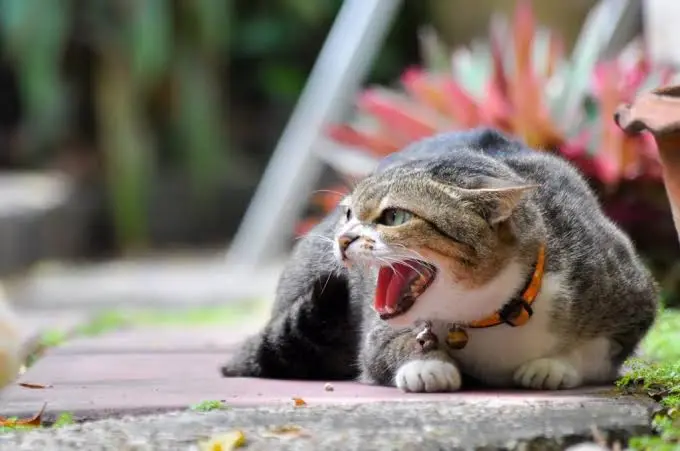
A cat hiss is usually a warning signal.
When a cat hisses, it is often trying to communicate that it feels uncomfortable and wants more distance from the person, animal, or situation around it.
A hiss can vary from a quieter open-mouth warning to a louder hiss that may be accompanied by other defensive signals, such as flattened ears, an arched back, raised fur, or an open mouth.
Think of it like a warning sign on a door.
The sign is not necessarily an attack.
It is telling you:
“Do not come closer right now.”
This is why punishing a cat for hissing can be counterproductive.
If you punish the warning signal without understanding the cause, your cat may become even more frightened or stressed.
A better approach is to ask:
What is my cat trying to communicate?
Is a Hissing Cat Always Aggressive?
No.
A hissing cat is not automatically an aggressive cat.
In fact, hissing is often associated with defensive behavior.
Cats may use a hiss because they want to avoid a physical confrontation rather than start one.
For example, imagine that a large unfamiliar dog approaches a cat.
The cat may not want to fight the dog.
Instead, it may hiss to communicate:
“Stay away from me.”
PetMD notes that hissing is commonly used as a defensive signal and can occur when a cat feels fearful or threatened.
However, a hiss can sometimes be part of a larger aggressive interaction.
That is why cat body language matters.
A cat that hisses and then moves away may be trying to avoid conflict.
A cat that hisses while continuing to advance, swat, chase, or attack may be involved in a more serious confrontation.
The hiss itself does not tell the entire story.
Why Do Cats Hiss?
There is no single answer to why do cats hiss.
Different situations can trigger the same sound.
Common causes of cat hissing include:
- Fear
- Feeling threatened
- Stress
- An unfamiliar person
- Another cat or animal
- Protecting kittens
- Territorial concerns
- Being annoyed or overstimulated
- Being touched when the cat does not want interaction
- Pain or physical discomfort
PetMD identifies fear, unfamiliar situations or animals, stress, annoyance, maternal protection, and pain among common reasons cats hiss.
The situation around the hiss often provides the biggest clue.
For example:
Your Cat Hisses When a Visitor Enters
The possible trigger may be fear or uncertainty.
Your Cat Hisses When You Keep Petting It
The cat may be overstimulated or simply want the interaction to stop.
Your Cat Hisses When You Touch One Specific Area
Pain or physical discomfort should be considered.
The sound may be the same.
The reason behind it may be completely different.
Cat Body Language Before and During Hissing
A hiss is often not the first sign that a cat is uncomfortable.
Cats can communicate through subtle body language before they reach the point of hissing.
Possible early warning signs include:
- Moving away
- Turning the head away
- A tense body
- Tail flicking
- Ears moving sideways
- Dilated pupils
- Crouching
- Becoming suddenly still
If these earlier signals are ignored, the cat may escalate to a more obvious warning such as hissing or growling.
PetMD explains that cats may show subtle changes in posture and body position before more obvious aggressive or defensive behavior occurs.
This is important because sometimes owners say:
“My cat hissed out of nowhere.”
But from the cat’s perspective, it may have already communicated several warnings.
Humans simply may not have noticed them.
What Does a Fearful Hissing Cat Look Like?
A frightened cat may use cat hissing as part of its defensive behavior.
You may notice:
- Flattened ears
- Dilated pupils
- Crouching
- A tucked or puffed tail
- Raised fur
- An arched back
- Moving away or hiding
Fearful cats may try to make themselves appear larger and more intimidating while also attempting to avoid the perceived threat.
PetMD describes hissing, flattened ears, dilated pupils, raised fur, crouching, and other posture changes as possible signals of fear or defensive behavior.
A frightened cat does not necessarily want to fight.
Often, it wants the threatening situation to end.
Giving the cat space can be much more effective than trying to force comfort or interaction.
Cat Hissing Because of Stress
Stress is another common reason for hissing cat behavior.
Cats can be sensitive to changes in their environment.
Possible sources of stress include:
- Moving to a new home
- Rearranging furniture
- Loud noises
- Visitors
- A new baby
- A new pet
- Construction work
- Changes in routine
What seems like a small change to you may feel significant to your cat.
For example, imagine that your cat normally sleeps peacefully in a quiet room.
One day, construction begins outside, unfamiliar people enter the home, and furniture is moved around.
Your cat may feel uncertain about its environment.
In this situation, hissing can be part of a stress response.
Loud unfamiliar noises and environmental changes are recognized triggers for fear-related and stress-related behavior in cats.
Why Does My Cat Hiss When It Feels Threatened?
A cat may hiss when it believes it cannot comfortably avoid a situation.
Possible triggers include:
- Someone approaching too quickly
- Being cornered
- A stranger trying to touch the cat
- Another animal coming too close
- A child repeatedly following the cat
- Being forced into a carrier
The cat may feel that its personal space is being ignored.
Hissing is one way to create distance without immediately using claws or teeth.
This is why it is important to respect the warning.
If a cat hisses and you continue moving closer, grabbing it, or trying to pet it, the situation may escalate.
PetMD advises backing away from a hissing cat and giving it space rather than trying to hold, stare at, or force comfort on the cat.
Cat Hissing Because of Annoyance or Overstimulation
Not every cat hissing episode is caused by extreme fear.
Sometimes your cat simply does not want to continue an interaction.
For example, you may be petting your cat.
At first, it appears happy.
After a while, you notice:
- Tail flicking
- Body tension
- Ears turning sideways
- The cat looking toward your hand
If petting continues, your cat may hiss.
Some cats become overstimulated when the same area is touched repeatedly.
Petting-induced aggression or irritation can occur when an interaction that initially feels pleasant becomes uncomfortable or overly stimulating for the cat.
This does not necessarily mean your cat suddenly dislikes you.
It may simply mean:
“That is enough for now.”
Learning to stop before your cat becomes overwhelmed can help reduce repeated hissing.
Why Does My Cat Hiss When I Touch It?
If your cat hisses when touched, there can be several possible explanations.
Your cat may:
- Not want physical contact at that moment
- Feel overstimulated
- Be startled
- Feel afraid
- Have pain in the area being touched
The location of the reaction can be important.
For example, if your cat only hisses when you touch one particular part of its body, physical discomfort should be considered.
PetMD notes that cats may hiss when a painful area is touched or when they anticipate pain.
Do not repeatedly test the painful area to see whether your cat hisses again.
Instead, observe for other signs such as:
- Limping
- Stiffness
- Reduced activity
- Difficulty jumping
- Hiding
- Changes in appetite
- Sensitivity to touch
A new or unusual reaction to touch may need veterinary attention.
Can Pain Cause Cat Hissing?
Yes.
Pain is one possible cause of sudden cat hissing, particularly when a normally calm cat suddenly reacts negatively to being touched or approached.
Medical problems that cause discomfort can change a cat’s behavior.
PetMD notes that pain can contribute to sudden aggression or defensive behavior, and conditions causing discomfort may lead a cat to hiss when touched or when it anticipates being touched.
Possible situations include discomfort related to:
- Injury
- Dental problems
- Arthritis
- Infection
- Other painful medical conditions
You cannot diagnose the cause simply by listening to the hiss.
However, a sudden change in hissing cat behavior should not automatically be dismissed as a personality problem.
If your cat is suddenly hissing much more than usual and you cannot identify an obvious trigger, a veterinary examination may be appropriate.
Why Does My Cat Hiss but Still Stay Near Me?
This can feel confusing.
Your cat may hiss at you but remain in the same room or even stay relatively close.
This does not necessarily mean the cat is sending mixed signals.
Your cat may feel comfortable with you overall while being uncomfortable with a specific action.
For example:
Your cat may enjoy sitting beside you.
But it may hiss when you try to pick it up.
The message may simply be:
“I want to stay here, but I do not want to be handled right now.”
This is why context is so important when understanding cat body language.
A hiss directed at your hand does not always mean your cat wants you to leave the room.
It may mean your cat wants one particular interaction to stop.
Learning to recognize these differences can make communication between you and your cat much easier.
Why Does My Cat Hiss at Me?
It can feel upsetting when your cat hisses directly at you.
You may immediately think:
“Did I do something wrong?”
The answer depends on what was happening before the hiss.
A cat may hiss at its owner because it:
- Feels startled
- Is afraid
- Does not want to be touched
- Is being picked up when it does not want to be
- Feels overst
How to Reduce Frequent Cat Hissing
The best way to reduce cat hissing is not to punish the hiss.
Instead, try to understand what is causing your cat to feel uncomfortable.
A hiss is often a warning signal. If you only try to stop the sound without addressing the reason behind it, your cat may continue feeling stressed, afraid, or uncomfortable.
Start by looking for patterns.
Ask yourself:
- Who is your cat hissing at?
- What happens immediately before the hiss?
- Does it happen in one specific location?
- Does your cat hiss when touched?
- Did the behavior begin suddenly?
- Has anything changed in your home?
Once you identify a possible trigger, you can work on reducing your cat’s stress and helping it feel safer.
Helping a Stressed Cat Feel Safer
A stressed cat may benefit from having more control over its environment.
Provide safe places where your cat can rest without being disturbed.
These may include:
- A quiet room
- A covered cat bed
- A cardboard box
- A high perch
- A cat tree
- A space away from other pets
Do not force your cat to interact with people or animals when it is clearly trying to avoid them.
For example, if your cat hides when visitors arrive, repeatedly bringing the cat out to “help it get used to people” may increase stress.
Instead, allow your cat to approach when it feels ready.
A calm environment and predictable routine can also help some cats feel more secure.
Try to keep important daily activities relatively consistent, including feeding and playtime.
Give a Hissing Cat Space
If your cat hisses, the simplest and safest response is often to stop what you are doing.
Do not:
- Move closer
- Chase the cat
- Grab the cat
- Force it to be held
- Continue petting
- Stare directly into its eyes
Instead, calmly create some distance.
If your cat hisses because you are trying to touch it, remove your hand and allow the cat to decide whether it wants to remain nearby.
Cats Protection advises giving a hissing cat space and considering the reason behind the behavior rather than treating the hiss itself as bad behavior.
Sometimes the interaction can be resumed later when your cat is calm.
Use Positive Associations Instead of Forcing Interaction
If your cat repeatedly hisses at a particular person, animal, or situation, forcing contact can make the problem worse.
A better approach is to help your cat gradually associate the situation with something positive.
For example, if your cat is nervous around a new family member:
- Allow the person to remain at a comfortable distance.
- Avoid forcing eye contact or physical interaction.
- Let the cat approach voluntarily.
- Use calm experiences, such as treats or play, when appropriate.
- Gradually build positive associations.
The important thing is to move at your cat’s pace.
If the cat starts showing stress signals or hissing, the situation may be moving too quickly.
How to Manage Cat Hissing in a Multi-Cat Household
Hissing can be common when cats are introduced too quickly.
A resident cat may hiss at:
- A new cat
- A new kitten
- A visiting cat
- A cat returning from a veterinary appointment
The goal should not be to force the cats to become friends immediately.
Instead, give them time to adjust.
A gradual introduction usually works better than placing unfamiliar cats together and hoping they “work it out.”
Start by providing separate spaces so each cat has access to its own:
- Food
- Water
- Litter box
- Resting area
- Hiding place
Allow the cats to become familiar with each other’s presence gradually.
Some initial hissing cat behavior may occur during introductions.
The key is to watch whether the interaction is gradually becoming calmer or whether fear and conflict are increasing.
If aggression becomes severe or repeated, professional behavioral guidance may be helpful.
Why Do Cats Hiss After Another Cat Comes Home From the Vet?
This situation can confuse many cat owners.
Your cats may normally get along well.
Then one cat returns from the veterinarian, and suddenly the other cat starts hissing.
One possible reason is that the returning cat smells different.
Veterinary clinics can leave unfamiliar scents on the cat’s fur.
The returning cat may also behave differently because it is stressed or uncomfortable.
As a result, the other cat may temporarily react as though something has changed.
Do not immediately force the cats to interact closely.
Give them time and space to settle.
If needed, temporarily separate them until they become calmer and can safely interact again.
When Cat Hissing May Be Related to Pain or Illness
Behavioral changes can sometimes be linked with medical problems.
A normally friendly cat that suddenly begins hissing, especially when touched, may be experiencing discomfort.
Pay attention to other changes, including:
- Limping
- Stiffness
- Difficulty jumping
- Hiding
- Reduced appetite
- Changes in grooming
- Changes in litter box habits
- Reduced activity
- Vocalizing more than usual
PetMD notes that pain can contribute to defensive and aggressive behavior in cats.
A hiss does not tell you what medical problem may be present, but sudden changes in behavior should not automatically be treated as a training issue.
If you suspect your cat may be in pain, avoid repeatedly touching or testing the sensitive area.
Contact a veterinarian for advice.
When Should You Contact a Veterinarian About Cat Hissing?
Consider contacting a veterinarian if cat hissing is:
- Sudden and unusual for your cat
- Becoming more frequent
- Triggered by touching a specific area
- Accompanied by changes in appetite
- Accompanied by weakness or reduced activity
- Occurring with difficulty walking or jumping
- Accompanied by hiding or other major behavioral changes
- Combined with signs that your cat may be in pain
A veterinarian can help determine whether a medical issue may be contributing to the behavior.
If no medical cause is identified and the hissing is related to fear, stress, or conflict, a qualified feline behavior professional may also be helpful.
Common Myths About Cat Hissing
Myth: A Hissing Cat Is Always Mean or Aggressive
False.
A hiss is often a defensive warning.
Your cat may be trying to avoid a fight rather than start one.
Myth: You Should Punish Your Cat for Hissing
False.
Punishment can increase fear and stress.
It may also teach your cat that warning signals are unsafe to express.
The better approach is to identify what is making your cat uncomfortable.
Myth: A Friendly Cat Will Never Hiss at Its Owner
False.
Even a loving cat may hiss when:
- Startled
- Overstimulated
- Frightened
- In pain
- Uncomfortable with being touched
One hiss does not erase your relationship with your cat.
Myth: Cats Hiss Only When They Are Angry
False.
Fear, stress, discomfort, pain, and uncertainty can all cause a cat to hiss.
Myth: A Cat That Hisses at Another Cat Will Never Accept It
Not necessarily.
Hissing can be normal during the early stages of a careful introduction.
What matters is whether the cats gradually become more comfortable or whether the conflict continues to escalate.
Frequently Asked Questions About Cat Hissing
Why is my cat hissing at me all of a sudden?
A sudden change can happen because of fear, stress, overstimulation, pain, or a change in the environment. If there is no obvious trigger or your cat shows other unusual symptoms, contact a veterinarian.
Why does my cat hiss but not attack?
Hissing is often a warning signal. Your cat may be trying to create distance and avoid physical conflict.
Should I hiss back at my cat?
No. Hissing back may confuse or further stress your cat. It is better to remain calm and give the cat space.
Why does my cat hiss when I pet it?
Your cat may be overstimulated, uncomfortable, startled, or experiencing pain. Watch for other body-language signals and stop petting when your cat shows signs of discomfort.
Why does my cat hiss at a new kitten?
Your cat may feel uncertain or territorial around the new kitten. A gradual introduction and separate resources can help reduce stress.
Why does my cat hiss at another cat after the vet?
The returning cat may smell unfamiliar or behave differently after the veterinary visit. Giving both cats time and space can help them settle.
Is cat hissing normal?
Yes. Occasional hissing can be a normal form of feline communication. Frequent, sudden, or unexplained hissing may need closer investigation.
How do I calm a hissing cat?
Stop approaching, give the cat space, reduce stress around it, and allow it to calm down before trying to interact again.
Final Thoughts
Cat hissing is not simply “bad behavior.”
In many situations, it is your cat’s way of communicating that something feels wrong, frightening, uncomfortable, or overwhelming.
The most useful response is to stay calm and look at the situation.
Ask what happened before the hiss.
Look at your cat’s body language.
Consider whether there has been a change in the environment, another pet, a new person, or your cat’s physical health.
A cat that hisses because it feels afraid needs space.
A cat that hisses because it is overstimulated needs the interaction to stop.
A cat that suddenly hisses when touched may need medical attention.
Once you stop treating the hiss as the problem and start looking at it as communication, hissing cat behavior becomes much easier to understand.
Your cat may simply be saying one very important thing:
“I am uncomfortable right now. Please listen.”